
AI Agent vs Call Center Agent for SMEs: ROI Comparison
Last updated:
For most SMEs, AI agents can deliver stronger ROI on repetitive, high-volume, and after-hours interactions, while human call center agents remain more valuable for complex, emotional, or revenue-sensitive conversations. The strongest economics often come from a hybrid model that automates predictable work while preserving human expertise for exceptions, sales, retention, and service recovery.
For a broader view beyond agent-level ROI, see our AI-Powered CX vs Traditional CX: Cost, Scale & Service analysis to compare the two customer experience operating models.
AI Agent vs Call Center Agent: Total Cost Comparison
The first difference SMEs should evaluate is not the headline price, but the structure behind that price. In an AI Agent vs Call Center Agent for SMEs cost comparison, businesses need to account for the full operating cost of each model rather than comparing an AI subscription directly with an employee’s salary.
Human Agent Costs Go Beyond Salary
Human customer support is primarily labor-driven. Whether an SME builds an internal team or uses an outsourced call center, expanding capacity usually means adding, training, scheduling, and supervising people.
| Cost Factor | Human Call Center Agent | AI Voice/Chat Agent |
| Primary cost base | FTE, hourly, seat, or service fees | Usage, conversation, API, or platform fees |
| Recruitment | Required for in-house teams | Not applicable |
| Training | Initial and ongoing | Configuration and knowledge updates |
| 24/7 coverage | Requires sufficient staffing or shifts | Can operate continuously |
| Scaling | More volume often requires more capacity | Can scale without proportional headcount |
| Hidden costs | Benefits, QA, WFM, supervision, turnover | Integration, telephony, AI usage, monitoring |
Salary alone can significantly understate labor cost. U.S. Bureau of Labor Statistics data for March 2026 shows that wages represented 69.9% of private-industry compensation, while benefits accounted for another 30.1%. Total employer compensation averaged $46.60 per hour, compared with $32.60 in wages.
For establishments with 1–49 employees, total compensation averaged $37.36 per hour, including $27.68 in wages and $9.68 in benefits.
These U.S. employer-cost figures are most relevant to in-house staffing. The economics can look significantly different when an SME compares AI with a domestic, nearshore, or offshore outsourced call center, where labor costs, management overhead, staffing flexibility, and pricing structures may differ from direct U.S. employment.
For this reason, SMEs should avoid comparing AI pricing with salary data alone. The more useful benchmark is the total cost required to resolve a customer interaction under each operating model.

What AI Agents Actually Cost
AI should not be treated as nearly free labor. Its total cost may include:
- AI platform and subscription fees
- LLM or API usage
- Telephony and voice processing
- CRM or helpdesk integrations
- Knowledge-base preparation
- Monitoring and quality assurance
- Human escalation capacity
For an SME, the meaningful comparison is therefore not agent salary versus AI subscription price.
It is:
Fully loaded human operating cost vs. fully loaded AI-enabled operating cost.
The answer may change depending on volume, complexity, location, integrations, and the percentage of contacts AI can actually resolve without escalation.
Beyond Labor Savings: Revenue and Capacity Effects
Reducing support cost is only one part of the ROI equation. AI can also create value by helping SMEs serve demand that would otherwise be difficult or uneconomical to cover.
This is why an AI Agent vs Call Center Agent for SMEs analysis should consider not only direct operating expenses but also missed leads, response times, after-hours coverage, conversion opportunities, and the amount of additional demand a business can handle without proportional hiring.

Capture After-Hours and Peak-Demand Opportunities
Customer expectations are moving quickly. Zendesk’s CX Trends 2026 research found that 74% of consumers expect customer service to be available 24/7 because of AI, while 88% expect faster responses than they did a year earlier.
For a human-only operation, extended coverage may require additional shifts, weekend staffing, overtime, and workforce forecasting.
AI can provide a first line of support for predictable requests such as appointment scheduling, basic lead capture, FAQs, order status, and simple account inquiries. In an AI-powered customer support outsourcing model, these automated interactions can also connect with business systems, customer context, and human escalation workflows.
The same principle can apply when SMEs outsource telemarketing. AI may assist with initial outreach, lead qualification, scheduling, and data capture, while trained human agents handle higher-value conversations that require persuasion, objection handling, or relationship building.
Scale Without Proportional Hiring
Consider an SME that normally receives 300 inquiries per week but generates 1,500 during a marketing campaign.
A human-only model may require temporary staff, overtime, or longer queues. An AI-enabled model can absorb part of the additional routine volume and escalate only cases that require human judgment.
The benefit is not unlimited scaling. Rather, the business becomes less dependent on proportional headcount growth whenever demand increases.
Faster Service Can Protect Revenue
Customer service also affects buying behavior.
Zendesk’s 2026 SMB research found that 86% of consumers say responsiveness and accurate resolution influence whether they purchase from a company or brand.
This means the ROI of AI may include more than labor savings. It may also include:
Cost savings + captured demand + recovered revenue + operational capacity.
Where AI and Human Agents Typically Deliver Better ROI
The ROI of each model depends heavily on the type of interaction being handled. AI tends to create more economic value when the workflow is structured and repeatable, while human agents create greater value when the interaction involves uncertainty, emotion, negotiation, or material revenue risk.
| Customer Interaction | AI Agent ROI Potential | Human Agent Value | Best-Fit Model |
| FAQs and basic information | High | Limited need for human involvement | AI |
| Order or account status | High | Usually unnecessary unless an exception occurs | AI |
| Appointment scheduling | High | Useful mainly for unusual requests | AI |
| After-hours inquiries | High | Requires additional staffing coverage | AI |
| Initial lead qualification | High for structured qualification | Stronger for complex or high-value opportunities | Hybrid |
| Tier-1 troubleshooting | High for known issues | Needed when diagnosis becomes complex | Hybrid |
| Complaints | Limited | High empathy and judgment requirements | Human |
| Service recovery | Limited | Stronger for exceptions and relationship management | Human |
| Retention conversations | Supportive role | High commercial and interpersonal value | Hybrid |
| Complex sales or advisory interactions | Supportive role | High judgment and persuasion requirements | Human |
This task-based approach is also relevant to live chat support outsourcing, where AI can handle repetitive Tier-1 inquiries while human agents step in for complex, sensitive, or higher-value conversations. The objective is therefore not to maximize automation across every interaction. It is to automate the contacts where AI can reduce cost without materially reducing service quality, while directing human capacity toward conversations where expertise creates greater economic value.
Which Model Delivers Better ROI for SMEs?
For most SMEs, the strongest operating model is unlikely to be AI-only or human-only.
AI is best positioned to absorb predictable, high-volume work, while human capacity is concentrated where judgment and customer value are highest.
In practice, that division of work also depends on how well context moves between AI, human agents, and customer channels. An AI-driven omnichannel CX model helps define where automation should act, when human escalation is required, and what customer information needs to follow the interaction.
A practical division may look like this:
AI handles:
- FAQs and status inquiries
- Appointment scheduling
- Basic qualification
- Routine transactions
- First-line triage
Human agents handle:
- Escalations and exceptions
- Complaints and service recovery
- Negotiation
- Retention
- Complex troubleshooting
- High-value sales or advisory interactions
Current workforce trends support this hybrid model. Gartner found that 85% of service and support leaders are expanding human-agent responsibilities as AI reduces contact volumes and shifts work toward higher-value tasks. Only 31% had implemented or planned AI-driven frontline workforce reductions through the first quarter of 2027.
Customer trust also matters. Gartner found that 54% of customers trust human agents more than AI for product or service recommendations, compared with 32% who trust AI more.
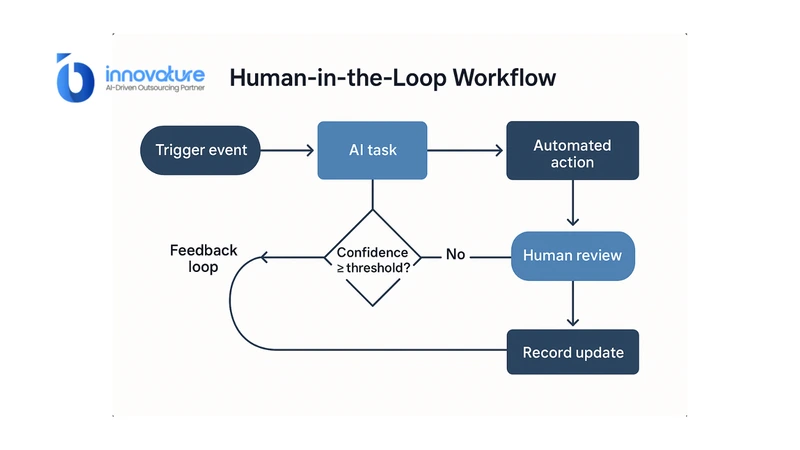
For an AI-enabled outsourced call center, the strategic opportunity is therefore not simply to minimize the number of agents. It is to use AI to reduce low-value workload so trained agents can focus on interactions where they have the greatest economic and customer impact.
How SMEs Should Evaluate ROI and Payback
A meaningful AI Agent vs Call Center Agent for SMEs ROI comparison should measure more than labor savings.

Measure Cost Savings
Include reductions in routine-agent workload, overtime, after-hours staffing requirements, and incremental staffing costs during demand growth.
Measure Recovered Revenue
Track whether faster or extended coverage captures:
- More leads
- More appointments
- More qualified opportunities
- Fewer abandoned contacts
- Higher conversion during peak periods
Measure Productivity Gains
Evaluate whether AI reduces repetitive work, improves first-contact resolution, increases contact capacity, or lowers average handling time.
A simplified ROI formula is:
ROI = (Cost Savings + Recovered Revenue + Productivity Value − Total AI Cost) ÷ Total AI Cost × 100
Example: SME AI Agent ROI Calculation
Consider an SME receiving 2,000 customer inquiries per month. The following scenario is illustrative rather than an industry benchmark, but it shows how a business can structure its ROI calculation.
Assume:
- Human handling costs average $7 per resolved interaction
- 1,200 monthly inquiries are suitable for AI-assisted handling
- AI successfully resolves 50% of those eligible contacts without human escalation
- 600 interactions are therefore resolved by AI
- The remaining 1,400 interactions still require human handling
- AI platform, usage, telephony, and monitoring costs total $1,500 per month
- Initial implementation and integration cost is $8,000
The comparison would look like this:
| Metric | Human-Only Model | AI + Human Model |
| Monthly inquiries | 2,000 | 2,000 |
| AI-resolved inquiries | 0 | 600 |
| Human-handled inquiries | 2,000 | 1,400 |
| Human handling cost | $14,000 | $9,800 |
| Monthly AI operating cost | — | $1,500 |
| Total monthly operating cost | $14,000 | $11,300 |
| Estimated monthly savings | — | $2,700 |
Under these assumptions, the SME reduces monthly operating costs by approximately $2,700, or $32,400 annually before implementation costs.
After accounting for the hypothetical $8,000 setup cost, first-year net savings would be approximately $24,400.
Using the ROI formula:
ROI = (Financial Benefit − Total AI Cost) ÷ Total AI Cost × 100
Annual human labor avoided in this example equals approximately $50,400. Total first-year AI costs equal approximately $26,000, including $18,000 in operating expenses and $8,000 in implementation costs.
This produces an illustrative first-year ROI of approximately 94%.
The $8,000 initial implementation cost would also be recovered in roughly three months if monthly net savings remained at approximately $2,700.
However, these results should not be treated as a standard SME benchmark. Actual ROI can vary substantially depending on contact volume, labor costs, AI pricing, automation eligibility, resolution accuracy, escalation rates, integration requirements, and customer behavior.
The most reliable approach is to replace each assumption with the SME’s own operating data before making an investment decision.
Key Metrics SMEs Should Track
Relevant KPIs include cost per interaction, cost per successful resolution, automation rate, escalation rate, FCR, conversion rate, and CSAT.
Salesforce’s 2026 State of Service research provides useful context. AI-agent adoption increased from 39% in 2025 to 66% in 2026, and 70% of organizations using AI agents reported measurable value within 60 days.
However, measurable value is not the same as full financial payback.
An SME’s break-even period will depend on its current labor baseline, interaction volume, integration costs, automation rate, escalation rate, and the revenue captured through better availability. ROI is only one part of the decision. SMEs comparing outsourcing partners should also understand how to evaluate BPO vendors across workforce quality, technology, security, KPIs, scalability, and contract terms.
Build the Right Customer Support Model With Innovature BPO
Choosing between AI agents and human call center agents does not have to be an all-or-nothing decision. The right model depends on your contact volume, customer expectations, workflow complexity, automation potential, and the level of human expertise required.
Innovature BPO helps SMEs build scalable customer experience operations by combining trained outsourced teams with technology-enabled workflows. Innovature’s customer support capabilities include:
- Inbound customer support
- Outbound sales and telemarketing
- Email and live chat support
- Multilingual customer support
- Technical support
- Virtual assistant services
- 24/7 customer service coverage
Depending on your requirements, Innovature can help assess which interactions should remain human-led, which workflows may benefit from automation, and how an outsourced or hybrid support model can improve operational efficiency while maintaining service quality.
If you are evaluating an outsourced call center, AI-enabled customer support, or a hybrid AI-human model, contact Innovature BPO to discuss your current workflows, support volume, staffing requirements, and growth plans.
Frequently Asked Questions
Are AI agents cheaper than call center agents?
AI agents can have lower unit costs for repetitive and high-volume interactions because capacity can increase without proportional headcount growth. However, SMEs should include platform fees, usage costs, telephony, integrations, monitoring, maintenance, and human escalation when calculating the true cost of AI.
How long does it take for an AI customer service agent to deliver ROI?
There is no standard payback period. ROI depends on implementation cost, contact volume, current labor cost, automation rate, escalation rate, and the amount of additional demand or revenue AI helps capture. SMEs should establish a financial baseline before implementation and measure savings and revenue impact against that baseline.
Can AI agents replace human call center agents?
AI can replace human involvement in some predictable workflows, but it is less suitable for interactions involving complex judgment, complaints, negotiation, retention, service recovery, or sensitive customer situations. For many SMEs, a hybrid model provides a better balance between operating efficiency and service quality.
What customer service tasks should SMEs automate first?
SMEs should generally begin with high-volume, repeatable, low-risk workflows such as FAQs, order status, appointment scheduling, simple account inquiries, Tier-1 support, and initial lead qualification. Starting with a narrow workflow makes it easier to measure automation rate, escalation rate, cost savings, CSAT, and financial return before expanding AI into more complex processes.

Outsourcing call centers are moving from traditional agent-led models to AI-enabled operations that combine automation with human expertise.…

Managing fragmented customer channels increases costs, repeat contacts, and service inconsistency across BPO operations. McKinsey reports that AI-powered…

Traditional CX and AI-Powered CX represent two different approaches to building customer service operations. While traditional models rely…

AI is becoming a core part of call center outsourcing. A 2026 Gartner survey found that 91% of…

Choosing the right outsourcing partner requires more than comparing pricing or available headcount. This guide explains how to…

AI-powered customer support outsourcing connects AI with outsourced teams to classify inquiries, retrieve customer context, automate approved tasks,…

SaaS companies can scale users faster than they can scale customer support. As ticket volumes rise, new markets…

Customer experience teams have no shortage of software options. The harder question is deciding which customer experience tools…

AI Voice Agent vs Human Call Center compares two different approaches to customer communication. AI Voice Agents use…

Call center outsourcing companies, also called CX outsourcing companies, run customer support for other businesses across phone, email,…

AI Voice Agent Integration in BPO call centers combines AI-powered voice technology with existing telephony, CRM, and customer…

Natural language processing bridges the gap between complex human communication and computational analysis, empowering modern enterprises to extract…
Ready to move faster?
Trust us to find the best-fit candidates while you concentrate on building a skilled and diverse remote team.