
Voice Agent vs Human Call Center: Comparison
Last updated:

AI Voice Agent vs Human Call Center compares two different approaches to customer communication. AI Voice Agents use automation to provide fast, 24/7 support at scale, while human call centers rely on trained agents for empathy, judgment, and complex problem-solving. Understanding these differences helps businesses choose the right model for their customer service needs, costs, and growth.
What is an AI Voice Agent?
An AI Voice Agent is an AI-powered system that handles customer conversations by phone. It can understand spoken requests, identify what customers need, and respond using business information, predefined rules, or connected systems.

For BPO and contact centers, AI Voice Agents can handle routine interactions such as FAQs, appointment scheduling, and order tracking. They can also connect with systems like a CRM or knowledge base to support AI Voice Agent integration in BPO call centers.
In short, an AI Voice Agent automates voice interactions that would otherwise require a human agent.
What is a Human Call Center?
A human call center is a customer service operation where trained agents communicate with customers by phone. They may handle inbound and outbound calls, customer support, sales inquiries, complaints, technical issues, and outsource telemarketing services for businesses.

Unlike AI Voice Agents, human agents rely on their experience, communication skills, and judgment to manage each conversation. A company can operate its own call center or work with an outsourced call center provider as part of a BPO service.
In short, a human call center relies on trained agents to manage customer conversations and resolve their needs.
Key Differences Between AI Voice Agents and Human Call Centers
AI Voice Agent vs Human Call Center comes down to several factors, including cost, response speed, scalability, customer experience, and the complexity of interactions. While AI Voice Agents are designed for fast and scalable routine support, human agents remain essential for complex and sensitive customer conversations.
| Metric / Feature | AI Voice Agent | Human Call Center |
| Cost per Interaction | $0.05–$0.50/minute | $3.00–$8.00+/session |
| Response Speed | Instant (0–2 seconds) | May involve hold time |
| Operating Hours | 24/7/365 standard | Limited by shift schedules |
| Scalability | Can handle thousands of calls simultaneously | Limited by available staffing capacity |
| Emotional Intelligence | Low / simulated | High / genuine empathy |
| Customer Experience | Consistent and process-driven | Personalized and empathetic |
| Complex Interactions | More limited | Stronger human judgment and problem-solving |
| Data Handling | Automated data capture and processing | May require manual data entry |
| Best Suited For | High-volume, repetitive, and routine interactions | Complex, sensitive, and relationship-driven interactions |
Cost Efficiency and Return on Investment (ROI)
Human agents can cost BPO centers around $3.00–$8.00+ per interaction, depending on call complexity and staffing. Labor is also one of the largest expenses in call center operations.
By comparison, AI Voice Agents can start at around $0.05–$0.15 per minute, while managed AI voice platforms typically cost $0.25–$0.50 per minute, according to Aircall’s AI Voice Agent pricing analysis. This makes AI particularly cost-effective for repetitive, high-volume interactions.
BPO centers also face high employee turnover. According to Insignia Resources, annual call center turnover typically ranges from 30% to 45%, with some centers reaching 60%. Replacing one employee can cost $10,000–$20,000 in recruitment, onboarding, and training. AmplifAI notes that, when lost productivity and customer churn are included, the total annual impact can exceed $1 million for a 100-agent contact center.
For businesses comparing AI Voice Agents with outsourced human support, the cost of the human model also depends on how the service is contracted. Dedicated hourly, usage-based, and performance-based structures distribute cost and operating risk differently. Reviewing the available call center pricing models can help businesses compare the total economics of human, AI, and hybrid support more accurately.
AI can reduce staffing needs for repetitive workloads and lower related recruitment and turnover costs. Many businesses can achieve payback within 3–6 months, although the actual timeline depends on call volume, use cases, and implementation costs.
Availability, Speed, and Scalability
Human call centers depend heavily on shift schedules and staffing capacity. During peak hours, higher call volumes can lead to longer queues and increased Average Speed of Answer (ASA). Customers may wait 30 seconds to several minutes before reaching an agent.
AI Voice Agents offer 24/7/365 availability with no traditional hold times. They can respond almost instantly, often within 0–2 seconds. For scalability, AI cloud infrastructure can handle thousands of concurrent calls, depending on system capacity. Human operations require additional staffing and workforce planning to scale during sudden traffic spikes.
Customer Experience (CX) and Emotional Intelligence
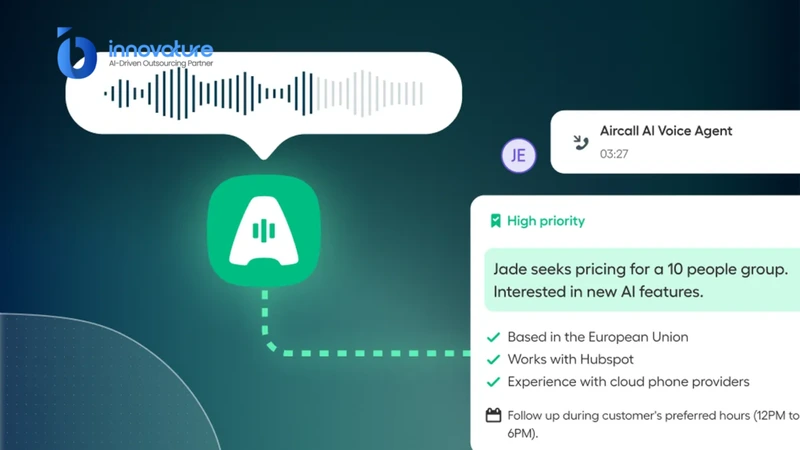
AI Voice Agents deliver consistent responses and service workflows without being affected by fatigue, stress, or mood. They can also capture interaction data and update CRM systems automatically, helping maintain consistent records. For businesses serving customers across different markets, multilingual customer support can also help maintain a consistent customer experience across languages and regions.
However, humans have a clear advantage in Emotional Intelligence (EQ). Human agents can recognize subtle vocal cues, understand customer emotions, and solve complex, unscripted problems, which can support higher First Contact Resolution. AI can simulate empathetic responses, but it may feel less natural during sensitive customer escalations or highly emotional conversations.

Data Security and Compliance
Data security is an important consideration when comparing AI Voice Agents and human call centers, particularly when customer conversations involve personal, financial, or other sensitive information. Each model presents different security risks and requires appropriate controls.
- AI Voice Agents: Can automate data handling through access controls, encryption, and controlled workflows, reducing some risks associated with manual processing. However, AI systems can still introduce risks such as cyberattacks, data exposure, and system vulnerabilities.
- Human Call Centers: Rely on trained agents and established security procedures to handle customer information. However, manual processing can increase the risk of human error, improper data handling, or unauthorized access.
When selecting a BPO provider, businesses should therefore evaluate not only the technology but also the provider’s security framework, data-handling practices, and relevant certifications. Key standards include ISO/IEC 27001:2022 for information security management, ISO/IEC 27701:2019 for privacy and personal data management, and HIPAA compliance for operations involving Protected Health Information (PHI).
Innovature BPO maintains these certifications and compliance standards, giving businesses an additional basis for evaluating its approach to information security, data privacy, and sensitive data management before deploying AI Voice Agents or outsourced customer support services.
Pros and Cons of Each Solution
AI Voice Agents and human call centers serve different operational needs.
AI Voice Agents
AI Voice Agents are well suited to businesses handling high volumes of routine customer interactions.
Pros
- Cost-effective: Reduces staffing needs for repetitive tasks.
- Fast and available: Provides quick responses and operates 24/7.
- Highly scalable: Handles large call volumes simultaneously.
- Consistent: Follows standardized workflows and responses.
- Efficient data handling: Automatically captures and records customer information.
Cons
- Limited human connection: Cannot fully replicate genuine human empathy.
- Complex situations: May require human support for unexpected cases.
- Local language limitations: May struggle with certain accents, dialects, or localized expressions.
- Implementation requirements: Requires appropriate systems, integrations, and security controls.
Human Call Centers
Human call centers remain valuable when customer interactions require empathy, flexibility, and human judgment.
Pros
- Genuine empathy: Responds naturally to customer emotions.
- Complex problem-solving: Handles difficult and unexpected cases effectively.
- Flexible: Adapts conversations to different customer situations.
- Trust-building: Creates stronger human-to-human connections.
Cons
- Higher operating costs: Requires ongoing staffing and workforce expenses.
- Harder to scale quickly: Capacity depends on available agents and shifts.
- Variable service quality: Performance can vary based on workload and individual agents.
- Limited availability: Coverage depends on operating hours and staffing schedules.
The Hybrid Approach: Combining AI and Human Agents
The most effective modern BPO strategy is not about replacing human agents with AI. It is about combining their strengths through a Hybrid Human-AI Model. AI handles high-volume routine interactions, while human agents focus on complex, sensitive, and high-value customer needs.
- Tier 1 Filtering (AI Voice Agents): AI acts as the first line of support and can handle 70% to 80% of high-volume, routine tasks. These include FAQs, appointment scheduling, and real-time order tracking, allowing customers to receive immediate assistance without waiting for a human agent.
- Tier 2 Escalation (Human Agents): When AI detects a complex issue or an emotionally sensitive interaction, it can perform a seamless live transfer to a human agent. Human specialists then handle technical troubleshooting, sensitive complaints, VIP customer care, and high-value sales negotiations.
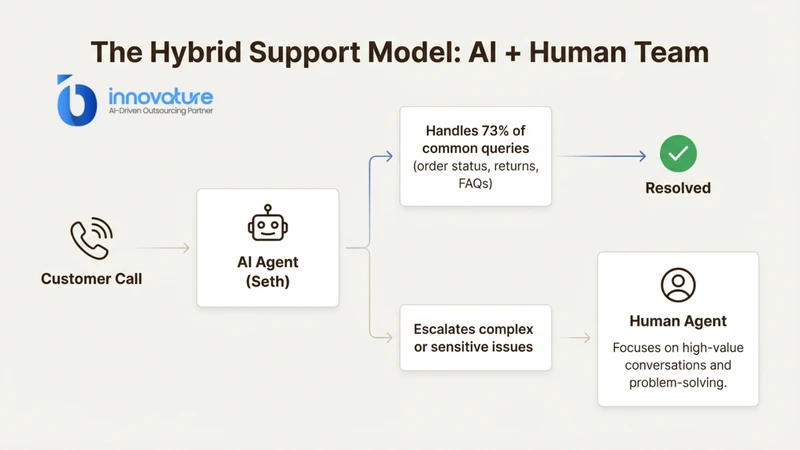
By separating routine and complex interactions, the hybrid model can reduce Average Handling Time (AHT) by up to 50%. It frees human agents from repetitive tasks so they can focus on emotionally driven and high-value customer interactions, creating a more efficient and scalable customer service operation.
For businesses exploring a hybrid customer service model, Innovature BPO’s customer service outsourcing solutions combine technology-enabled processes with experienced BPO teams and established service workflows. This approach gives businesses greater flexibility to scale support, maintain service quality, and adapt operations as customer volumes and business requirements change.
Ready to build a more scalable customer support operation? Contact Innovature BPO to discuss a customer service model tailored to your business needs.

Outsourcing call centers are moving from traditional agent-led models to AI-enabled operations that combine automation with human expertise.…

Managing fragmented customer channels increases costs, repeat contacts, and service inconsistency across BPO operations. McKinsey reports that AI-powered…

Traditional CX and AI-Powered CX represent two different approaches to building customer service operations. While traditional models rely…

AI is becoming a core part of call center outsourcing. A 2026 Gartner survey found that 91% of…
For most SMEs, AI agents can deliver stronger ROI on repetitive, high-volume, and after-hours interactions, while human call…

Choosing the right outsourcing partner requires more than comparing pricing or available headcount. This guide explains how to…

AI-powered customer support outsourcing connects AI with outsourced teams to classify inquiries, retrieve customer context, automate approved tasks,…

SaaS companies can scale users faster than they can scale customer support. As ticket volumes rise, new markets…

Customer experience teams have no shortage of software options. The harder question is deciding which customer experience tools…

Call center outsourcing companies, also called CX outsourcing companies, run customer support for other businesses across phone, email,…

AI Voice Agent Integration in BPO call centers combines AI-powered voice technology with existing telephony, CRM, and customer…

Natural language processing bridges the gap between complex human communication and computational analysis, empowering modern enterprises to extract…
Ready to move faster?
Trust us to find the best-fit candidates while you concentrate on building a skilled and diverse remote team.