

In business organizations, the terms “Front Office” and “Back Office” are commonly used to categorize different functions or departments within a company. While both play crucial roles in the overall functioning of an organization, there are distinct differences between the two. This article will provide a comprehensive comparison of Front Office vs Back Office functions, highlighting their roles, responsibilities, and contributions to the success of a business.
What Is the Front Office?

The front office refers to the customer-facing or client-facing departments or functions within an organization. It is the first point of contact for customers and plays a crucial role in managing interactions, providing customer service, and building relationships with clients and external stakeholders.
The front office serves as the face of the organization and represents its brand image and reputation. It is responsible for creating positive customer experiences, addressing inquiries and concerns, and ensuring customer satisfaction. The main objective of the front office is to serve as a bridge between the organization and its customers, delivering value and building long-term relationships.
Roles and Duties in the Front Office

The front office encompasses various roles and duties that are essential for managing customer interactions, providing excellent service, and building relationships. Typically, the front office includes departments such as customer service, sales, marketing, public relations, and sometimes reception or concierge services. Each department within the front office has specific roles and responsibilities:
Customer Service: The customer service department is responsible for handling customer inquiries, resolving issues or complaints, providing information about products or services, and ensuring customer satisfaction. Customer service representatives are trained to address customer needs and provide excellent support.
Sales: The sales department focuses on generating revenue by selling products or services to customers. Sales representatives engage with potential customers, present offerings, negotiate terms, and close deals. They play a vital role in driving revenue growth and expanding the customer base.
Marketing: The marketing department is responsible for promoting the organization’s products or services, creating brand awareness, and attracting customers. Marketing professionals develop marketing strategies, conduct market research, manage advertising campaigns, and utilize various channels to reach and engage target audiences.
Public Relations: The public relations (PR) department manages the organization’s reputation and public image. PR professionals handle media relations, press releases, crisis communication, and strategic communication initiatives. They work to maintain a positive perception of the organization among the public and stakeholders.
Reception/Concierge Services: In some organizations, a reception or concierge service is part of the front office. These roles involve greeting visitors, answering phone calls, managing appointments, and providing general assistance to customers or clients.
What Is the Back Office?

The back office refers to the internal operations and support functions within an organization that are essential for its smooth functioning. Unlike the front office, which focuses on customer-facing activities, the back office primarily handles administrative, operational, and support tasks that support the overall operations of the business.
The back office plays a vital role in ensuring that the organization’s internal processes are efficient, resources are managed effectively, and compliance requirements are met. While the back office may not have direct interactions with customers, its work is crucial for the success and sustainability of the organization.
See more» Back Office in Business: To Outsource or Not?
Roles and Duties in the Back Office

The back office encompasses various roles and duties that are essential for the internal operations and support functions of an organization. Here are some common roles and their associated responsibilities within the back office:
Finance and Accounting
The finance and accounting department is responsible for managing financial resources and ensuring accurate financial records. Roles within this department include:
- Accountants: Accountants handle tasks such as financial reporting, bookkeeping, accounts payable and receivable, and tax compliance. They analyze financial data, prepare financial statements, and ensure adherence to accounting standards.
- Financial Analysts: Financial analysts analyze financial data, conduct financial forecasting and modeling, and provide insights and recommendations to support decision-making. They monitor financial performance, identify trends, and contribute to budgeting and strategic planning processes.
- Payroll Specialists: Payroll specialists manage employee compensation, process payroll, and ensure compliance with payroll-related regulations. They calculate wages, deductions, and benefits, maintain payroll records, and address employee inquiries regarding compensation.
Human Resources
The human resources department is responsible for managing various aspects related to employees and the workforce. Roles within this department include:
- HR Managers: HR managers oversee all HR functions and strategies within the organization. They develop HR policies, manage employee relations, facilitate talent acquisition and retention, and ensure compliance with labor laws and regulations.
- Recruiters: Recruiters are responsible for sourcing, attracting, and selecting qualified candidates for open positions within the organization. They screen resumes, conduct interviews, coordinate hiring processes, and onboard new employees.
- Training and Development Specialists: Training and development specialists design and deliver training programs to enhance employee skills and knowledge. They assess training needs, develop training materials, facilitate workshops or sessions, and evaluate training effectiveness.
IT Support
The IT support team is responsible for managing and maintaining the organization’s information technology infrastructure and providing technical support to employees. Roles within this team include:
- IT Managers: IT managers oversee the organization’s IT operations and strategies. They manage IT budgets, coordinate system upgrades or implementations, ensure data security, and align IT initiatives with business objectives.
- Help Desk Technicians: Help desk technicians provide technical assistance and support to employees. They troubleshoot hardware or software issues, resolve technical problems, and provide guidance on IT-related inquiries or requests.
Operations
The operations department manages the day-to-day operational activities of the organization. Roles within this department include:
- Operations Managers: Operations managers oversee the overall operational performance and efficiency of the organization. They develop and implement operational strategies, monitor processes, optimize resource allocation, and ensure quality control.
- Supply Chain Specialists: Supply chain specialists manage the organization’s supply chain activities, including procurement, inventory management, logistics, and supplier relationships. They coordinate with suppliers, monitor inventory levels, optimize delivery processes, and identify cost-saving opportunities.
Compliance and Risk Management
The compliance and risk management function ensures that the organization operates by applicable laws, regulations, and industry standards. Roles within this function include:
- Compliance Officers: Compliance officers develop and implement compliance programs, policies, and procedures. They monitor regulatory changes, conduct compliance audits, provide training on compliance-related matters, and ensure adherence to legal and regulatory requirements.
- Risk Managers: Risk managers identify and assess risks that may impact the organization. They develop risk management strategies, implement risk mitigation measures, monitor risk exposure, and establish frameworks for managing operational, financial, and reputational risks.
These are just a few examples of roles and responsibilities within the back office. Depending on the organization and industry, there may be additional specific roles that support internal operations, administrative tasks, and specialized functions. The back office functions play a critical role in supporting the overall functioning of the organization and ensuring its efficiency, compliance, and operational success.
Front Office vs Back Office vs Middle Office
Here’s a comparison of the Front Office, Back Office, and Middle Office in terms of their functions, responsibilities, and characteristics:
Functions and Responsibilities
Front Office
The front office is responsible for customer-facing activities, revenue generation, and building relationships with customers or clients. It handles tasks such as sales, customer service, marketing, and public relations. The front office focuses on attracting and retaining customers, providing support, and representing the organization’s brand image.
Back Office
The back office is responsible for internal operations, administrative tasks, and support functions. It handles activities such as finance and accounting, human resources, IT support, compliance, and operations. The back office ensures efficient internal processes, manages resources, maintains compliance, and supports the overall functioning of the organization.
Middle Office
The middle office acts as a bridge between the front office and back office. It is responsible for risk management, trade support, and transaction processing. The middle office analyzes risks, ensures compliance with regulations, and supports the execution and processing of trades or transactions. It plays a crucial role in facilitating smooth operations between the front and back offices.
Focus
Front Office
The front office’s primary focus is on customer service, revenue generation, and building relationships with customers or clients. It aims to provide excellent customer experiences, meet sales targets, and drive business growth.
Back Office
The back office’s primary focus is on internal operations, administrative tasks, and supporting the overall functioning of the organization. It ensures efficient processes, manages resources effectively, and supports the front office and other areas within the organization.
Middle Office
The middle office’s focus is on risk management, trade support, and transaction processing. It analyzes risks, ensures compliance with regulations, and supports the execution and processing of trades or transactions to facilitate smooth operations.
Visibility
Front Office
The front office is customer-facing and highly visible to customers or clients. It directly interacts with them, representing the organization and its brand.
Back Office
The back office is primarily internal-facing and less visible to customers. Its work is essential for the organization’s operations but may not be directly seen by external stakeholders.
Middle Office
The middle office is typically internal-facing but may have limited visibility to external stakeholders. Its work is crucial for managing risks, supporting trades, and ensuring regulatory compliance.
Skill Sets
Front Office
The front office often requires strong interpersonal skills, communication skills, sales abilities, and customer service expertise. It focuses on building relationships, understanding customer needs, and meeting sales targets.
Back Office
The back office requires various skills depending on the specific roles within departments such as finance, accounting, human resources, IT support, and operations. Skills in administration, finance, technical expertise, compliance, and process management are often essential.
Middle Office
The middle office typically requires skills in risk management, data analysis, trade support, and regulatory compliance. Strong analytical abilities, attention to detail, and knowledge of relevant regulations are often important in this area.
While there are distinct differences between the front office, back office, and middle office, it’s important to note that they all contribute to the overall functioning and success of an organization. Collaboration and effective communication between these areas are crucial for achieving organizational objectives and delivering value to customers or clients.
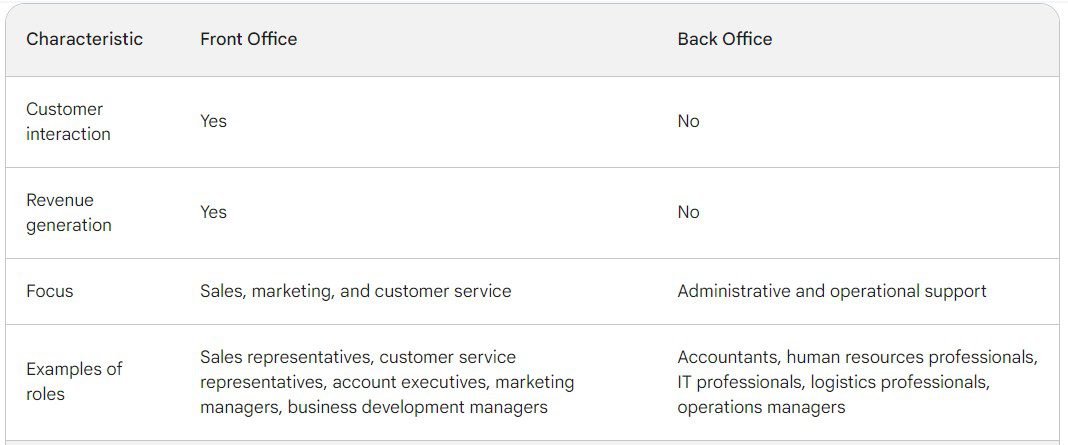
Key Differences Between the Front Office vs Back Office

Front Office
Interacts with customers directly.
Generates revenue for the company.
Focuses on sales, marketing, and customer service.
Examples of front office roles include:
- Sales representatives
- Customer service representatives
- Account executives
- Marketing managers
- Business development managers
Back Office
Do not interact with customers directly.
Supports the front office by providing administrative and operational functions.
Examples of back office roles include:
- Accountants
- Human resources professionals
- IT professionals
- Logistics professionals
- Operations managers
Key Differences
Importance of the Front Office and Back Office
Both the Front Office and Back Office are essential for the success of a business. The front office generates revenue and builds relationships with customers, while the back office provides the administrative and operational support that the front office needs to function.
The lines between the Front Office and Back Office are becoming increasingly blurred in today’s digital world. For example, many sales representatives now use customer relationship management (CRM) software to track customer interactions and manage their pipeline. This software is typically hosted in the cloud, which means that it can be accessed by both Front Office vs. Back Office employees.
Similarly, many back office employees now use customer-facing technologies such as live chat and social media to interact with customers. This allows them to provide support to customers in a more timely and efficient manner.
Overall, the Front Office and Back Office are two important parts of any business. By working together, they can help the business to achieve its goals.
Both Front Office vs Back Office functions are integral parts of any organization, and their collaboration is essential for overall success. While the front office focuses on customer interactions and relationship management, the back office ensures smooth internal operations and provides support to the front office. Recognizing the differences and synergies between these Front Office and Back Office allows organizations to optimize their operations, enhance customer experiences, and achieve their business objectives effectively.
See more >>


Building A Stronger Dedicated Team Through Direct Client Collaboration in Vietnam Building a dedicated team in Vietnam should…

In 2026, Manufacturing BPO in Vietnam is expanding in both scale and service maturity. Competitive operating costs, a…

When it comes to the Business Process Outsourcing (BPO) industry, India has repeatedly proven itself to be a…

Expanding a veterinary network through aggressive acquisitions generates immense revenue potential but frequently exposes hidden administrative vulnerabilities when…

The global economy currently experiences constant fluctuations that force business leaders to rethink their traditional growth formulas. During…

Executive Summary: The Modern Virtual Assistant Landscape Managing multiple clients, complex admin workflows, and tight deadlines requires more…

Hiring a virtual assistant often starts with a simple problem: too much work and not enough time. But…
In-house vs outsourcing depends on the level of control, expertise, and flexibility your business needs. In-house teams are…

Time is the most valuable resource in a medical practice, yet physicians are currently losing a staggering amount…

The financial landscape for US businesses has shifted into a period of extreme oversight that many are calling…

In today’s fast-paced logistics industry, managing administrative tasks efficiently is more important than ever. Many companies struggle to…

Forget the mortgage compliance playbook you thought you knew. The year 2025 has triggered a seismic shift in…
Ready to move faster?
Trust us to find the best-fit candidates while you concentrate on building a skilled and diverse remote team.