
Data Annotation Services: Scope, Quality and Cost Guide
Last updated:

Data annotation services turn raw images, text, audio, and video into labeled datasets for defined machine learning tasks. Choosing a provider requires more than comparing rates: buyers need clear deliverables, measurable quality, appropriate data access, and a process for resolving disputed labels. This guide explains service types, delivery models, provider evaluation, pricing considerations, and pilot requirements so you can assess an annotation project before committing to larger volumes.
What Are Data Annotation Services?

Data annotation services organize people, tools, and review processes to add agreed labels or attributes to data. Depending on the contract, the work may include preparing guidelines, assigning annotators, checking labels, resolving exceptions, and delivering files in a specified format. The scope should distinguish labeling from related activities such as collecting source data, developing models, or evaluating model performance.
Annotation supports supervised learning by providing examples of expected outputs, but it is not a requirement for every machine learning approach. IBM distinguishes labeled and unlabeled training data, including their use in supervised and unsupervised learning. For an explanation of individual techniques, see our guide to data annotation types and examples. Here, the focus is how to evaluate the service around those techniques.
Common Service Types and Expected Outputs
When comparing data annotation services, start with the task your dataset must support rather than selecting a provider based only on industry claims. A project brief should specify what annotators must identify, how they should represent it, and how the receiving team will use the files. The examples below illustrate possible requirements; they are not a list of deliverables included in every service.
For an example of how label requirements change by sector, see how data annotation supports banking and investing workflows, from fraud labels to KYC review.
| Service Type | Example Task | Output to Specify |
|---|---|---|
| Image annotation | Locate products or mark visible defects | Object classes, boxes or masks, required attributes, and image identifiers |
| Video annotation | Track an object across selected frames | Frame references, object identifiers, labels, and visibility rules |
| Text annotation | Classify requests or identify named entities | Approved categories, text spans, and rules for ambiguous language |
| Audio annotation | Transcribe speech or label sound events | Transcripts, timestamps, speaker labels where required, and uncertainty markers |
For projects involving large language models, clarify whether the scope includes preparing examples, collecting human feedback, or evaluating generated responses. These activities need their own instructions and acceptance criteria. Amazon SageMaker Ground Truth, for example, describes human feedback across model customization and evaluation. Do not assume that an image-labeling workflow or its quality metric will transfer unchanged to language evaluation.

In-House, Managed and Hybrid Delivery Models
When evaluating data annotation services, separate who manages the work from the technology used to support it. An internal team and an external provider can both use annotation platforms or AI-assisted tools. For each option, document who assigns tasks, answers questions, reviews output, and approves changes. The comparison below is a planning framework, not a guarantee that one model will be cheaper or more accurate.
| Delivery Model | How Responsibilities Can Be Divided | Buyer Consideration |
|---|---|---|
| In-house | The company manages annotators, tools, review, and delivery | Can internal specialists support both production volume and quality review? |
| Managed service | The provider manages agreed production and review activities; the client approves requirements and acceptance | Which responsibilities and outputs are included in the service fee? |
| Hybrid | An external team handles defined production tasks while internal specialists resolve selected cases or validate results | Are handoffs and response times clear enough to prevent blocked work? |
If a provider uses crowdsourced contributors or subcontractors, ask how workers are selected, trained, supervised, and authorized to access your data. For AI-assisted annotation, agree which suggestions require review and how errors will be detected. A platform license does not, by itself, establish who is responsible for the finished dataset.
How to Evaluate a Data Annotation Provider
Compare data annotation services against the same written requirements and an agreed sample of your work. Ask for evidence that explains how the proposed team will deliver your task, not only a presentation describing broad capabilities. The assessment should cover task fit, quality measurement, data handling, and usable outputs before you compare production rates or commit to a larger engagement.
Task and Domain Fit
Ask the provider to explain how its team would handle representative examples, including unclear inputs and cases requiring specialist judgment. Confirm who trains annotators, answers domain questions, and maintains the instructions. A useful demonstration should show the reasoning behind difficult labeling decisions, rather than only displaying finished examples selected by the provider. Request references or project evidence relevant to your task where available.
Quality Measurement and Rework
Require a definition of each proposed quality metric, including the unit measured, review sample, and threshold for acceptance. A statement such as “99% accuracy” is not enough without explaining whether it refers to images, individual objects, text labels, or reviewed fields. Agree which errors require correction, who pays for rework, and how the corrected output will be checked before delivery is accepted.
Data Access and Security Requirements
Map the information annotators actually need, then use NIST’s least-privilege principle to frame access requirements. Ask where data is stored, who can download it, whether subcontractors receive access, and how access is removed. Document retention, deletion, incident reporting, and any proposed use of your data for other purposes. Have the appropriate internal owner approve sensitive-data arrangements before work begins.
Tooling, Output Formats and Portability
Request a sample export before approving the tooling. Check whether labels, identifiers, timestamps, and other required fields can be imported into your existing workflow without manual reconstruction. Confirm access to guidelines, reviewed annotations, and project records when the engagement ends. Our overview of data annotation tools provides additional software context; provider evaluation should establish responsibility for the work performed with those tools.
From Project Brief to Accepted Dataset

Structure data annotation services around reviewable outputs rather than treating delivery as one final handoff. The workflow below brings together guidelines, calibration, production review, and acceptance. Agree which document or result must be approved at each stage, and name the person who can make that decision. This helps both teams distinguish unfinished labeling, unresolved questions, and completed work ready for use.
1. Write a Project Brief
Describe the task, source data, required labels, delivery format, expected volume, and review responsibilities. Include instructions for incomplete or ambiguous inputs rather than leaving annotators to invent their own rules. The following example is an illustrative brief for a product-image project, not an Innovature client case study or a universal specification. Adapt its fields to the work you actually need.
| Brief Component | Illustrative Requirement |
|---|---|
| Task | Identify approved product categories in supplied images |
| Label rules | Use the agreed category list and document partially hidden or unclear objects |
| Delivery format | Return labels linked to the correct image identifiers in the agreed export structure |
| Quality evidence | Provide review results and a record of errors and corrections |
| Decision owner | Name the client reviewer who approves instructions and resolves disputed cases |
2. Calibrate Before Expanding Production
Run a pilot containing routine examples and deliberately selected difficult cases. Review disagreements with the annotators and update the guidance before increasing volume. Keep examples used for training separate from independent acceptance checks where practical. A gold set should contain reviewed reference annotations, with an owner responsible for correcting the reference itself when the project reveals an error or an unclear rule. If an external team will carry that volume, our guide to data annotation outsourcing covers role splits, QA layers and security checks before access begins.
3. Review Quality and Resolve Exceptions
Track both aggregate results and the types of error found during review. Record recurring misunderstandings, assign an owner, and check whether the correction requires rework, training, or a guideline change. CVAT’s quality-control documentation illustrates the use of reference annotations, quality reports, and conflict review. Use the table below as a suggested acceptance checklist, adapted to your task and risk level.
| Check | Evidence to Request |
|---|---|
| Label correctness | Results against approved references using the agreed metric |
| Difficult-case handling | A record of disputed cases and approved decisions |
| Rework completion | Corrected items and results of the follow-up review |
| Output usability | A successful import test and required-field checks |
| Batch acceptance | A named approval owner and a record of remaining exceptions |
Review performance across relevant categories and conditions, not only an overall score. Agreement between annotators should not be treated as proof that a label is correct. Where examples are subjective, document the evaluation rubric and disagreement policy. Annotation checks also do not replace separate testing of the resulting model or a review of whether the source data adequately represents the intended task.
4. Deliver, Accept and Maintain the Dataset
Request the agreed annotation files alongside the label definitions, guideline version, quality report, and outstanding-issue log. Test a sample in the receiving workflow before signing off the batch. Record later changes to labels or instructions so affected work can be identified. Recheck annotations when requirements change, and remove access or arrange deletion according to the agreed project-close process.
Data Annotation Pricing and Cost Drivers

For data annotation services, ask providers to state the pricing unit: an hour of work, an annotated item, a defined batch, or dedicated capacity. Specify what an “item” includes and whether review, corrections, tools, onboarding, and project management are covered. An image containing one simple object should not automatically be treated as equivalent to an image requiring many detailed annotations.
Compare quotations using the same sample, label instructions, quality requirements, and turnaround expectations. Ask which changes would trigger additional charges, including new classes, specialist review, difficult source material, and revised outputs. Include the time your internal team will spend answering questions, reviewing batches, and preparing data. This produces a clearer comparison than treating the quoted annotation rate as the entire project cost.
One useful planning measure is:
Cost per accepted item = Total project cost / Number of items meeting the agreed acceptance criteria.
For illustration, a project costing $1,000 with 800 accepted items costs $1.25 per accepted item. These figures are hypothetical, not market rates or Innovature pricing. Define the cost period and count each accepted item once, even when it has been corrected. Compare results only where the scope and acceptance criteria are equivalent.
Buyer Checklist Before Scaling Delivery
Before scaling data annotation services, confirm that the pilot has answered the questions below. A completed batch is not sufficient evidence if instructions remain disputed or the receiving team cannot use the output. Use the checklist to identify what must be resolved before expanding the engagement, and record any accepted limitation rather than allowing it to become an unstated assumption.
- Scope: Are labels, exclusions, volumes, and output formats agreed?
- Quality: Are the review method, acceptance thresholds, and rework rules documented?
- Ownership: Are guideline changes, exceptions, and final approvals assigned?
- Security: Are access, permitted data use, retention, and deletion requirements approved?
- Delivery: Has the export been tested, and can review capacity support the proposed volume?
Discussing Your Annotation Project With Innovature BPO
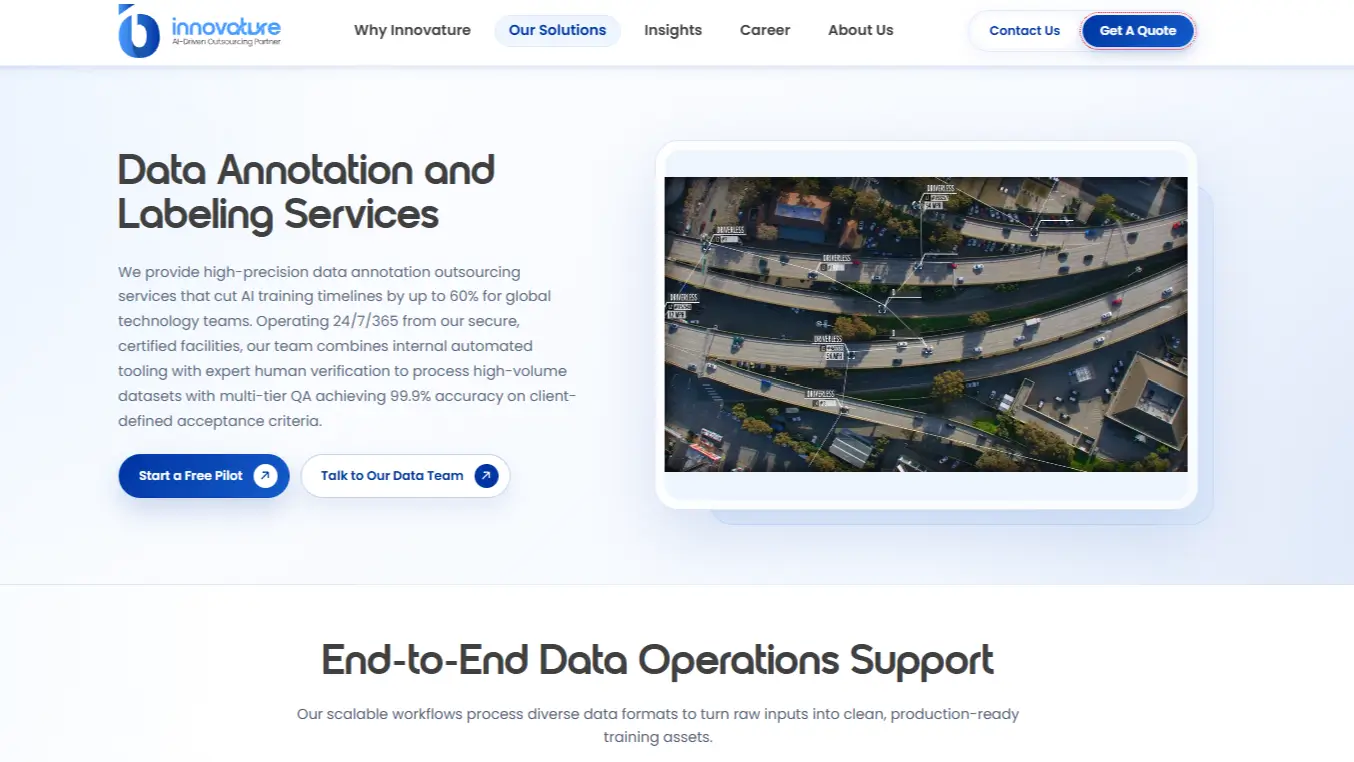
Businesses evaluating data annotation services can explore Innovature’s data annotation and labeling services and compare the published scope with their project requirements. Prepare a brief covering data types, task examples, expected volumes, delivery format, quality criteria, and access restrictions. These details provide a practical starting point for discussing task fit, responsibilities, and the information needed to evaluate a pilot.
To review a potential engagement, discuss your annotation requirements with our team. Confirm the proposed scope, review process, and acceptance conditions before sharing sensitive data or committing to production volumes.
Frequently Asked Questions
What Should I Include in a Data Annotation Project Brief?
Include the intended task, data types, example inputs, label definitions, estimated volume, output format, and delivery schedule. Add quality requirements, access restrictions, and the person responsible for clarifying ambiguous cases. Specify whether data preparation, review, or model evaluation is part of the requested service.
How Do I Compare Quotes From Annotation Providers?
Give providers the same sample and requirements. Compare what their price includes, how they define a billable item, and what triggers extra charges. Evaluate total project cost alongside accepted output, review effort, turnaround, and the conditions for correcting work that fails the agreed checks.
How Should Annotation Quality Be Evaluated During a Pilot?
Agree on the metric, reference examples, review sample, and acceptance threshold before work starts. Inspect difficult cases as well as routine ones, and record how disagreements are resolved. Ask for error-level findings and correction results rather than relying solely on a headline accuracy percentage.
Can AI-Assisted Annotation Replace Human Review?
AI assistance can generate proposed labels, but the project still needs a defined validation process. Decide which outputs can pass automated checks, which require review, and how missed errors will be detected. Evaluate the workflow against your task requirements rather than assuming automation makes every output acceptable.
What Should Be Delivered Alongside the Annotated Dataset?
Request the agreed label definitions, guideline version, quality report, and exception log alongside the annotation files. Confirm that file identifiers and export fields work in your receiving system. Document acceptance and any remaining limitations so the next team understands what was reviewed and what remains unresolved.


Data analytics outsourcing with AI can shorten parts of data preparation, query development, and reporting. The value is…

Outsourcing data analytics can add specialist skills, flexible capacity, and more reliable reporting without requiring a business to…

Data Security in Outsourcing: How ISO 27001 Protects Client Data Outsourcing gives external teams access to business processes,…

How to outsource data entry successfully depends less on how quickly a provider can add people and more…

Data Entry Outsourcing: Understanding Cost and Benefits Data entry may look like a straightforward operational task, but its…

Data annotation outsourcing assigns defined labeling and review work to an external team while the client retains responsibility…

A Germany-based logistics provider operating in Vietnam needed a more reliable way to process invoices and related freight…

Logistics data entry outsourcing gives carriers, freight brokers, 3PLs, and other logistics teams external capacity for repetitive shipment-data…

Document processing outsourcing moves repetitive document intake, classification, extraction, validation, exception handling, and system handoff to an external…

Data processing outsourcing for ecommerce assigns defined catalog, marketplace, inventory, order, and record-maintenance tasks to a specialized external…

Logistics analytics outsourcing services help logistics companies turn operational data from TMS, WMS, ERP, carrier, billing, and tracking…

Data annotation in finance turns selected documents, transactions, financial text, and review outcomes into labeled datasets for AI…
Ready to move faster?
Trust us to find the best-fit candidates while you concentrate on building a skilled and diverse remote team.