
What Is Benchmarking? Why Is It Important in Business?
Last updated:
Meeting internal KPIs does not necessarily mean a business is performing well against its peers. A customer service team, for example, may respond quickly yet resolve fewer issues on the first contact than comparable teams. Benchmarking puts these results into context, helping businesses identify performance gaps and determine where improvements are needed.
This guide explains what is benchmarking, why it matters in business, and how organizations can apply different benchmarking approaches to improve operational efficiency and make more informed decisions.
What Is Benchmarking in Business?
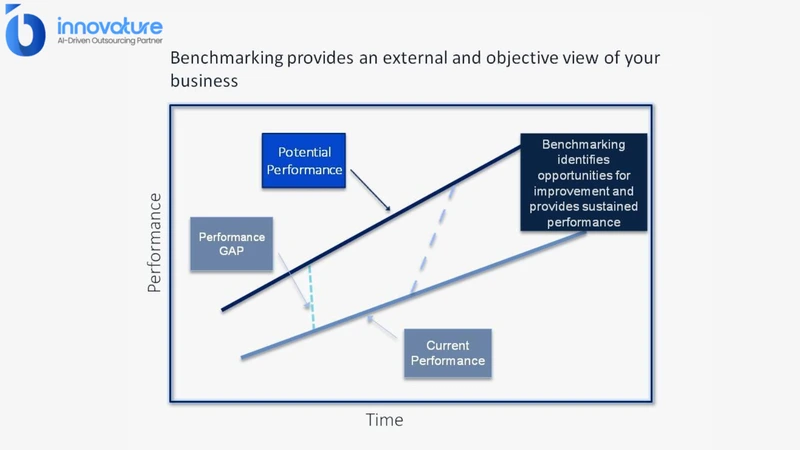
Benchmarking in business is a structured process of comparing a company’s performance, processes, or operating practices against relevant internal or external reference points. It helps organizations identify performance gaps, understand what drives those differences, and pinpoint opportunities to improve efficiency, service quality, and operational outcomes.
Comparisons may involve internal teams, competitors, leading organizations in other industries, or published industry data. A benchmark is a reference point, while a performance baseline captures the company’s current results. Benchmarking connects the two through measurement and analysis.
For example, a finance team might compare its cost per invoice with data from organizations handling similar Accounts Payable workloads. Any gap prompts a closer look at approval workflows, staffing, and automation before deciding what to change.
Types of Benchmarking in Business
Benchmarking can be grouped into two main categories: by who a business compares itself with and by what it evaluates. The table below outlines six common types of benchmarking based on these two perspectives.
| Classification | Type of Benchmarking | Primary Focus |
| By Comparison Target | Internal Benchmarking | Teams or business units within the same organization |
| Competitive Benchmarking | Direct competitors | |
| Functional Benchmarking | Similar business functions across organizations | |
| By Evaluation Focus | Performance Benchmarking | KPIs and measurable operational outcomes |
| Process Benchmarking | Workflows, procedures, and operating practices | |
| Strategic Benchmarking | Long-term strategies and operating models |
These classifications are not mutually exclusive. For example, a company can combine internal and performance benchmarking to compare invoice-processing KPIs across departments, then use process benchmarking to identify the reasons behind performance differences.
Benchmarking by Comparison Target
- Internal Benchmarking: Compares performance across departments, branches, or business units within the same organization. For example, two Accounts Payable teams may process similar invoice volumes but achieve different turnaround times. Comparing their workflows, staffing arrangements, and exception-handling practices can reveal opportunities to improve internal operations.
- Competitive Benchmarking: Measures a company’s performance against direct competitors using indicators such as pricing, response times, service quality, and customer satisfaction. By analyzing publicly available information and reliable market research, businesses can assess their competitive position and identify areas for improvement.
- Functional Benchmarking: Evaluates specific business functions against organizations performing similar activities effectively, even outside the same industry. For instance, an e-commerce company might study how a hospitality business handles customer complaints to identify practices that could improve its own customer service operations.
Benchmarking by Evaluation Focus
- Performance Benchmarking: Focuses on measurable outcomes using KPIs such as cost per transaction, processing accuracy, turnaround time, and first-contact resolution. These comparisons help businesses quantify performance gaps and establish realistic improvement targets. Financial benchmarking applies the same principle to costs, margins, and working capital, although metrics alone cannot explain the causes of performance differences.
- Process Benchmarking: Examines how work is carried out, including workflows, standard operating procedures (SOPs), approval stages, and quality controls. Consistent process definitions are essential for meaningful comparisons. APQC’s Process Classification Framework (PCF) provides a common language for organizing business processes, while its 2025 survey found that 75% of responding organizations used a process framework.
- Strategic Benchmarking: Examines how organizations approach long-term priorities, including business models, technology investments, resource allocation, and expansion strategies. For example, a growing enterprise might compare how other companies structure operations across internal teams, shared service centers, and external providers to evaluate scalability and operational control.
Why Is Benchmarking Important? Key Benefits for Businesses
The benefits of benchmarking extend beyond measuring performance against internal targets. By comparing costs, efficiency, and service quality against relevant benchmarks, organizations can identify weaknesses and focus on improvements that deliver meaningful business value.
- Identify Performance Gaps: Benchmarking reveals where costs, processing times, or error rates exceed comparable standards. These insights help businesses pinpoint underperforming areas and investigate the causes rather than relying on assumptions.
- Set Realistic Performance Goals: Reliable benchmarks provide a basis for setting achievable KPIs. Businesses can align performance targets with operational capacity, service requirements, and industry expectations instead of adopting arbitrary standards.
- Improve Operational Efficiency: Comparing processes can uncover unnecessary approvals, repetitive tasks, and inefficient workflows. Addressing these issues can reduce rework, shorten processing times, and improve resource utilization without compromising quality.
- Support Data-Driven Decisions: Benchmarking provides evidence for decisions about technology investments, workforce allocation, and process improvements. Leaders can prioritize initiatives with the greatest potential operational impact.
- Strengthen Continuous Improvement and Competitiveness: Regular benchmarking helps businesses track progress, adapt proven practices, and respond to changing market expectations while maintaining consistent service quality and cost control.
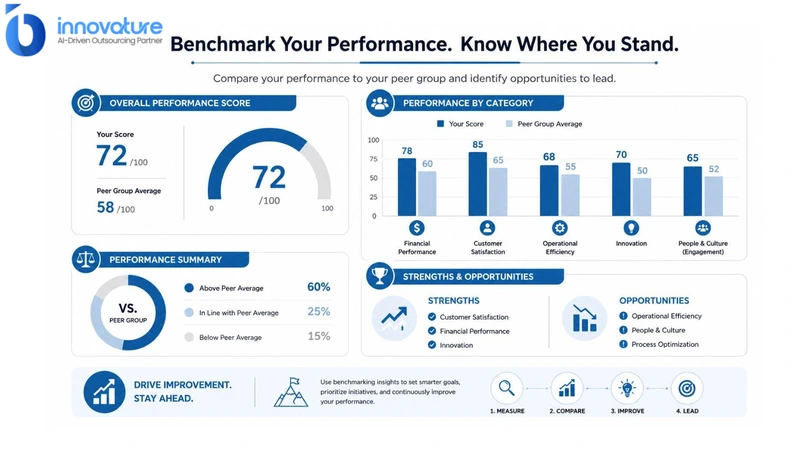
Benchmarking alone does not improve performance. Its value comes from turning reliable comparisons into targeted actions and measuring the results.
How to Conduct Benchmarking in 5 Steps
An effective benchmarking process starts with identifying what needs improvement, measuring current performance, and comparing results against relevant benchmarks. The findings then guide practical changes that can be evaluated over time.
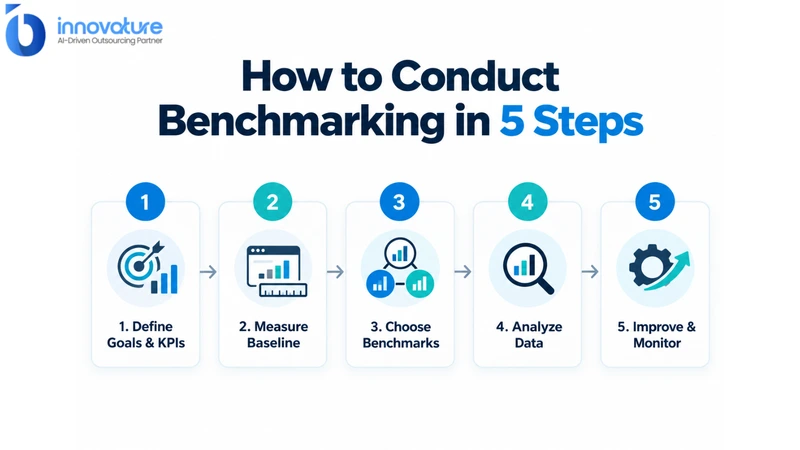
Step 1: Define Benchmarking Objectives and Key Performance Indicators (KPIs)
Start with a clear business problem, such as high operating costs, processing delays, or inconsistent service quality. Identify the processes involved and select KPIs that directly measure the issue. For example, an Accounts Payable team could track cost per invoice and processing accuracy to understand whether its operations are both cost-effective and reliable.
Step 2: Establish a Performance Baseline
Before looking at external benchmarks, document how the process currently performs. Use internal reports, ERP systems, or operational dashboards to capture relevant metrics over a consistent period. Record transaction volumes, processing times, costs, and error rates where applicable. This baseline provides a reliable starting point for measuring performance gaps and tracking future improvements.
Step 3: Select Relevant Benchmarks and Comparison Groups
Identify appropriate reference points, such as other business units, industry benchmarks, or organizations with similar operations. Comparisons should account for differences in company size, transaction volume, process complexity, and service requirements. For instance, invoice processing costs are more meaningful when compared with organizations handling similar workloads and approval requirements, rather than relying on broad industry averages alone.
Step 4: Collect, Normalize, and Analyze Benchmarking Data
Gather the necessary data and make sure the measurements are comparable. Data analytics and business intelligence can support KPI reporting and highlight performance differences, but metric definitions, reporting periods, and cost calculations must first be aligned. Once the data is consistent, investigate what may be driving the gaps. A higher cost per transaction, for example, may reflect manual data entry, frequent exceptions, or inefficient approval workflows rather than staffing levels alone.
Step 5: Address Performance Gaps and Monitor Improvements
Use the findings to prioritize changes that address the identified problems. These may include simplifying approval procedures, updating standard operating procedures (SOPs), improving employee training, or introducing automation. Assign clear responsibilities and measurable targets, then review KPIs after implementation to confirm whether the changes improve efficiency, accuracy, and service quality.
Real-World Benchmarking Examples in Business
Benchmarking delivers the most value when organizations use performance comparisons to understand operational weaknesses and identify practical improvements. The following cases show how businesses have applied this approach.
Finance & Accounting: Benchmarking Accounts Payable Operations
A global automotive manufacturer struggled to assess Accounts Payable (AP) performance across approximately 50 European entities using different ERP systems – a common challenge when evaluating finance and accounting operations at scale. In a 2026 project documented by Roland Berger, the company benchmarked more than 15 operational KPIs against industry peers and digitally advanced organizations.
The analysis identified opportunities to simplify approvals, improve exception handling, and expand automation. It revealed a potential 24% reduction in manual invoice-processing effort, providing a quantified basis for future improvements rather than reporting savings already achieved.
Customer Service: Co-op’s Benchmarking Initiative
UK retailer Co-op wanted to improve its customer service operations using insights from more than one million annual customer conversations. The company benchmarked its contact center against the Bright Index before analyzing customer feedback and unresolved complaints.
The findings informed staff training, service improvements, and ongoing CSAT monitoring. According to the published case study, customer satisfaction in complaint handling improved by 20%, alongside 6% higher post-complaint member retention.
Common Benchmarking Challenges and How to Overcome Them
While benchmarking provides valuable performance insights, unreliable comparisons and poor execution can lead to misleading conclusions. Businesses should address four common challenges:
- Selecting Inappropriate Benchmarks: Comparing organizations with different operating models, transaction volumes, or service requirements can distort results. Choose comparable peer groups and account for relevant operational differences.
- Inconsistent Metrics and Data Quality: Similar KPIs may use different calculations, cost components, or reporting periods. Standardize metric definitions and validate data before making comparisons.
- Limited Access to Reliable Data: Competitor performance data is often unavailable or incomplete. Use internal benchmarks, credible industry reports, and legally accessible third-party data instead.
- Turning Insights Into Action: Benchmarking findings have little value without follow-through. Assign process owners, establish improvement targets, and regularly review KPIs to track progress.
Organizational support also matters. According to APQC’s 2025 survey, 76% of respondents to a question about process framework implementation challenges cited buy-in and engagement, reinforcing the importance of clear ownership and cross-functional alignment.
Frequently Asked Questions About Benchmarking
What Is the Difference Between Benchmarking and Performance Measurement?
Performance measurement tracks business results against established KPIs and targets. Benchmarking goes further by comparing those results with relevant internal teams, industry standards, or peer organizations to identify performance gaps and opportunities for improvement.
How Often Should a Business Conduct Benchmarking?
The frequency depends on business objectives and how quickly operating conditions change. Annual benchmarking may support strategic planning, while quarterly reviews can help teams manage rapidly evolving processes. Major operational changes may also warrant reassessment.
Can Businesses Benchmark Without Access to Competitor Data?
Yes. Businesses can compare internal departments, use credible industry reports, or examine similar functions in other organizations. Reliable data, consistent metric definitions, and appropriate comparison groups matter more than direct access to competitors’ information.
Conclusion
Benchmarking helps businesses move beyond measuring performance to understanding where meaningful improvements are possible. Its value lies in translating reliable comparisons into better operational decisions.
If your business is looking to improve finance, customer service, or back-office operations, contact Innovature BPO to discuss your operational needs and explore suitable solutions.


Building A Stronger Dedicated Team Through Direct Client Collaboration in Vietnam Building a dedicated team in Vietnam should…

In 2026, Manufacturing BPO in Vietnam is expanding in both scale and service maturity. Competitive operating costs, a…

When it comes to the Business Process Outsourcing (BPO) industry, India has repeatedly proven itself to be a…

Expanding a veterinary network through aggressive acquisitions generates immense revenue potential but frequently exposes hidden administrative vulnerabilities when…
The global economy currently experiences constant fluctuations that force business leaders to rethink their traditional growth formulas. During…

Executive Summary: The Modern Virtual Assistant Landscape Managing multiple clients, complex admin workflows, and tight deadlines requires more…

Hiring a virtual assistant often starts with a simple problem: too much work and not enough time. But…
In-house vs outsourcing depends on the level of control, expertise, and flexibility your business needs. In-house teams are…

Outsourcing prior authorization can help healthcare practices manage the paperwork, payer follow-ups, and documentation requests that put pressure…

The financial landscape for US businesses has shifted into a period of extreme oversight that many are calling…

In today’s fast-paced logistics industry, managing administrative tasks efficiently is more important than ever. Many companies struggle to…

Forget the mortgage compliance playbook you thought you knew. The year 2025 has triggered a seismic shift in…
Ready to move faster?
Trust us to find the best-fit candidates while you concentrate on building a skilled and diverse remote team.