
Outsourcing call centers are moving from traditional agent-led models to AI-enabled operations that combine automation with human expertise. Automated self-service, real-time agent assistance, intelligent routing, AI-assisted quality assurance, and language localization help providers scale efficiently, improve service consistency, and support global customers. This article explores the benefits, operational applications, industry use cases, and evaluation criteria for AI-enabled call center outsourcing.
Benefits of AI-Powered Call Center Services
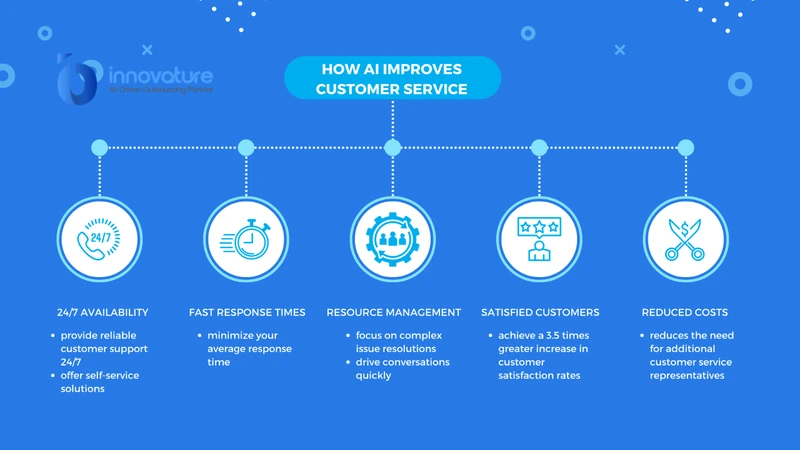
AI-powered call center services can improve outcomes for customers, agents, and operations teams by reducing repetitive work and making relevant information easier to access.
Key benefits include:
- Faster responses and shorter wait times: Chatbots, voicebots, and automated routing can resolve common requests or connect customers with the right agent more quickly.
- Greater scalability: AI helps call centers manage sudden increases in call, chat, email, and ticket volumes without relying entirely on seasonal recruitment or rapid workforce expansion.
- Higher agent productivity: Real-time knowledge suggestions, automated summaries, and CRM updates reduce the time agents spend searching across systems and completing after-call work.
- More consistent service quality: AI can guide agents through approved scripts, workflows, knowledge base content, and compliance requirements across teams, shifts, and service locations.
- Better operational visibility: Conversation analytics can identify customer intent, contact drivers, sentiment, escalation risks, and recurring service issues.
- More accessible global support: Translation, speech enhancement, and language localization tools can improve communication between offshore teams and customers in international markets.
These benefits depend on more than adding a chatbot or AI assistant. Businesses evaluating customer service outsourcing solutions should assess how the provider integrates AI with CRM, telephony, ticketing, and knowledge management systems.
Providers also need clear escalation workflows and measurable performance standards. Common KPIs include Average Handle Time, First Contact Resolution, Customer Satisfaction, Containment Rate, Escalation Rate, and Error Rate.
Core AI Transformations in Outsourcing Call Centers
AI is changing how outsourcing call centers manage interactions before, during, and after each customer conversation. The strongest results usually come from using AI to support agents and automate well-defined workflows rather than attempting to remove human involvement entirely.
Automated Self-Service
AI chatbots and virtual assistants can handle structured, repetitive requests such as:
- Checking order status.
- Booking or rescheduling appointments.
- Resetting passwords.
- Retrieving account information.
- Answering frequently asked questions.
- Providing standard delivery or return information.
Unlike traditional IVR systems that require customers to navigate fixed menus, conversational Voice AI can interpret natural language and identify the reason for contact. Customers can describe what they need instead of selecting from a long list of predefined options.
Robotic Process Automation can then complete supporting actions, such as:
- Creating or categorizing tickets.
- Completing standard data fields.
- Updating CRM records.
- Sending confirmation emails.
- Transferring information between approved systems.
- Triggering follow-up workflows.
For document-intensive workflows, optical character recognition (OCR) can extract data from scanned forms, invoices, and image-based files. Robotic process automation (RPA) can then validate the information and enter it into the CRM or another approved system. In a UiPath case study, Max Healthcare reported 65%–75% time savings across selected claims-processing workflows.
In an outsourced inbound call center, similar automation can reduce repetitive data entry and allow agents to spend more time on requests requiring judgment, empathy, or deeper product knowledge.
When an automated system cannot resolve an issue confidently, it should transfer the conversation to a human agent. The transfer should include the customer’s details, conversation history, identified intent, and any actions already completed. This prevents the customer from having to explain the same issue again.
Real-Time Agent Assistance
Generative AI can support agents during live conversations by identifying the customer’s intent and displaying relevant information, including:
- Knowledge base articles.
- Product information.
- Return and refund policies.
- Troubleshooting instructions.
- Verification requirements.
- Compliance reminders.
- Recommended next actions.
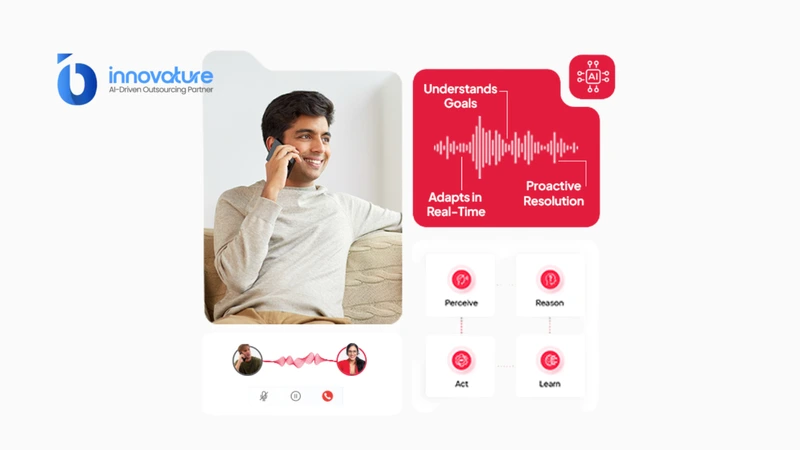
The system may also produce real-time transcripts, summarize the conversation, and prepare call notes for the CRM. This reduces the administrative work agents must complete after each interaction.
An AI assistant is only as reliable as the information behind it. If the knowledge base contains outdated policies, incomplete product details, or conflicting instructions, the system may deliver the wrong answer more quickly rather than improve service quality.
Providers therefore need a defined process for reviewing and updating knowledge content. Agents must also be able to verify AI-generated suggestions before communicating them to customers.
AI should support decision-making rather than replace accountability. Human agents remain responsible for final decisions involving complaints, refunds, retention offers, policy exceptions, financial information, or sensitive customer circumstances.
Intelligent Call and Ticket Routing
Traditional IVR systems use fixed menus and route calls based mainly on the option selected by the customer. Intelligent routing examines more context before deciding where the interaction should go.
Routing factors may include:
- Customer intent.
- Preferred language.
- Interaction history.
- Customer segment.
- Sentiment or urgency.
- Product or service category.
- Required technical skills.
- Agent availability.
This allows the system to connect customers with the agent or team most likely to resolve the issue. Relevant customer information can also be displayed before the agent accepts the conversation.
When implemented correctly, intelligent routing can reduce unnecessary transfers and shorten the path to the right support resource. It may improve First Contact Resolution while reducing Transfer Rate, Average Handle Time, and Abandonment Rate.
However, routing models need ongoing monitoring. Incorrect intent classification can send customers to the wrong queue, while poorly defined priority rules may cause routine requests to be treated as urgent. Providers should review routing outcomes and adjust rules based on actual contact data.
Businesses supporting customers across different regions should also consider how routing works across time zones. A combination of automation, workforce planning, and outsourcing call centers operating across multiple time zones can help maintain coverage without placing the full burden on one local team.
Enhanced Quality Assurance and Coaching
Traditional quality assurance often depends on supervisors manually reviewing a limited sample of recorded calls. As a result, managers may miss recurring problems that appear outside the reviewed sample.
AI-assisted quality assurance can analyze a much broader range of voice and digital interactions. Depending on the configuration, the system may identify:
- Script adherence.
- Required verification steps.
- Compliance language.
- Customer sentiment.
- Long periods of silence.
- Escalation signals.
- Repeated customer objections.
- Potentially inappropriate language.
- Missed process steps.
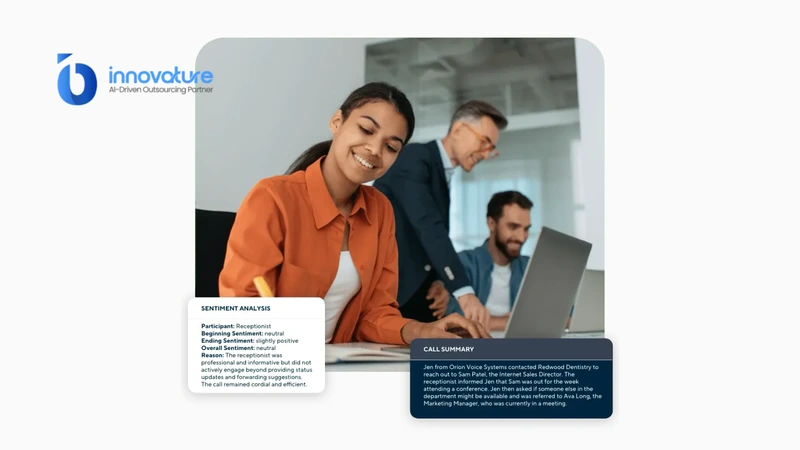
AI can produce preliminary quality scores or flag conversations that require human review. Supervisors gain faster visibility into recurring issues and can focus their time on interactions with higher operational or compliance risk.
The same data can support more targeted coaching. Instead of providing identical training to every agent, managers can identify specific gaps, such as incomplete verification, weak objection handling, unclear explanations, or missed escalation opportunities.
This can also support onboarding. New agents receive feedback based on real interactions rather than waiting for a monthly performance review.
AI-generated scores should not be treated as final without context. A system may detect that an agent departed from a script without recognizing that the agent made a reasonable decision for an unusual customer situation. Supervisors still need to consider the full conversation and the agent’s judgment before confirming a score or taking corrective action.
Advanced Language and Accent Localization
AI-powered language and voice technologies can help offshore teams communicate more clearly with customers across international markets.
Common capabilities include:
- Real-time language translation.
- Live transcription.
- Accent adaptation.
- Noise cancellation.
- Speech enhancement.
- Standardized industry terminology.
Each technology serves a different purpose. Translation converts speech or text between languages. Accent adaptation adjusts pronunciation while preserving the agent’s intended message. Noise cancellation removes background sounds that may affect call clarity.
These tools can help outsourcing call centers reduce communication barriers, but they should not be used to misrepresent an agent’s identity or conceal the service location. Their purpose should be to improve clarity and accessibility.
Before expanding these technologies across a full operation, providers should run a controlled pilot and evaluate:
- Translation accuracy.
- Speech recognition accuracy.
- Processing latency.
- Audio quality.
- Performance with industry terminology.
- Agent feedback.
- Customer feedback.
Performance may vary depending on language, accent, connection quality, call environment, and the platform being used. Human review remains important for sensitive conversations and languages where the system has lower accuracy.
Industries That Benefit Most From AI Call Centers
AI-enabled outsourcing call centers can create value across industries where customers expect fast responses, accurate information, and consistent service across multiple channels.
E-commerce and Retail
AI can handle order tracking, payment questions, return requests, delivery updates, and refund status inquiries. During major promotions or seasonal peaks, automation can absorb sudden increases in call and chat volume while directing exceptions to the appropriate agent.
Banking, Financial Services, and Insurance
AI may support identity verification, request classification, fraud alerts, policy inquiries, document collection, and compliance monitoring. However, sensitive transactions, claims decisions, and financial recommendations should remain under qualified human review.
Healthcare
Virtual assistants can support appointment booking, reminders, service information, and patient call routing. AI can also summarize interactions and classify requests. Access to personal and health information must be restricted according to applicable privacy and security requirements.
Telecommunications and Technology
AI can recognize common technical issues, recommend troubleshooting steps, collect device information, classify support tickets, and route customers to specialized technical teams.
Travel and Hospitality
AI can support reservations, itinerary changes, disruption notifications, loyalty inquiries, and multilingual assistance. Human agents remain important when customers need alternative travel arrangements or support during urgent disruptions.
Real Estate and Home Services
AI can qualify leads, schedule property viewings, arrange service appointments, route maintenance requests, and track tenant or customer follow-ups.
Businesses that outsource telemarketing may also use AI to prioritize leads, recommend relevant talking points, record call outcomes, and schedule follow-up activities. Agents should still control the conversation and adapt the script based on the prospect’s actual needs.
How to Evaluate AI-Enabled Outsourcing Call Centers
Not every provider uses AI in the same way. Businesses should determine whether the technology solves a genuine operational problem, works with existing systems, and maintains appropriate human oversight.
These considerations should form part of a broader assessment of the pros and cons of outsourced customer service.

Match AI Capabilities to Customer Service Needs
Start by identifying the channels, contact volumes, and customer requests the outsourced team will manage.
Ask the provider which use cases the technology supports, such as:
- Ticket classification.
- Agent assistance.
- Call summaries.
- Customer authentication.
- Self-service.
- Document processing.
- Quality monitoring.
The goal is not to select the provider with the longest list of AI features. The technology should address a defined service problem, such as high after-call work, slow ticket routing, inconsistent quality monitoring, or excessive repetitive contacts.
Review System Integration Capabilities
Effective call center outsourcing solutions should integrate with the systems already used by the business, including:
- CRM platforms.
- Ticketing systems.
- Telephony platforms.
- Knowledge bases.
- Reporting tools.
- Automation platforms.
Confirm whether the provider supports API or webhook integration and how customer data moves between systems.
A well-designed setup should give agents a consistent view of the customer interaction rather than requiring them to repeatedly switch between disconnected platforms.
Verify Human Escalation Workflows
Businesses should understand exactly when AI transfers a conversation to an agent.
Escalation rules should cover:
- Low-confidence responses.
- Customer complaints.
- Sensitive personal information.
- Payment or account security issues.
- Policy exceptions.
- Repeated self-service failure.
- Requests involving legal, financial, or healthcare decisions.
The receiving agent should have access to the conversation history and any actions already completed by the automated system.
Assess Data Security and Compliance
Review how the provider manages:
- User access permissions.
- Data storage.
- Data retention.
- Call recordings.
- Customer consent.
- AI model access.
- Third-party technology vendors.
- Incident response.
- Business continuity.
Compliance requirements may include GDPR, HIPAA, or PCI DSS depending on the industry, market, and type of information involved.
Certifications such as ISO 27001 may provide additional evidence that the provider follows structured information security practices. However, certification does not replace a detailed review of the systems, people, and subcontractors involved in the specific account.
Confirm KPIs, Pilot Scope, and Reporting
Before deployment, define the pilot scope, reporting schedule, baseline performance, and success criteria.
Relevant KPIs may include:
- Average Handle Time.
- First Contact Resolution.
- Customer Satisfaction.
- Containment Rate.
- Escalation Rate.
- Transfer Rate.
- Abandonment Rate.
- Error Rate.
- After-Call Work.
- Quality Assurance Score.
The provider should compare the pilot results with the original baseline and explain what caused the improvement. Performance changes may come from AI, workflow redesign, better training, knowledge base updates, or a combination of factors.
A controlled pilot makes it easier to identify weaknesses before applying the technology across the entire customer support operation.
Optimize Customer Experience With Innovature BPO
AI delivers better customer experience outcomes when it is supported by trained agents, documented workflows, and consistent quality control. Innovature BPO combines dedicated customer support teams with the client’s existing technology environment to support inbound and outbound calls, email, live chat, and social media.
This model allows businesses to improve service efficiency while maintaining control over customer data, operating procedures, and performance standards.
How Innovature Integrates AI Into Customer Experience Operations
Innovature can work with the client’s existing CRM, ticketing, telephony, knowledge management, and automation platforms to support AI-enabled customer service workflows.
Depending on the service requirements, AI and automation can assist with:
- Ticket classification and intelligent routing
- Real-time knowledge suggestions for agents
- Call transcription and interaction summaries
- Document data extraction and CRM updates
- Quality monitoring and performance analysis
Innovature can also support the operational framework required to manage these tools effectively, including:
- Knowledge transfer and standard operating procedures
- Ticket handoff and escalation workflows
- QA scorecards and agent performance reviews
- SLA, KPI, and service reporting
Routine tasks can be automated to reduce administrative work, while complaints, policy exceptions, sensitive information, and complex customer requests can be routed to trained agents for review.
Case Study: 0% Delayed Daily Responses for a US Insurer
In a 12-month engagement, Innovature BPO supported a US insurance company across its inbound and outbound customer service operations. The project scope included:
- Handling 100% of inbound and outbound call requirements
- Managing customer emails and supporting attachments
- Assisting with quotation and policy submission workflows
- Coordinating document checks and follow-up activities
- Supporting communication across insurance platforms
The project achieved 0% delayed daily responses, helping the client maintain consistent communication throughout the insurance submission and underwriting process.
This result reflects the importance of clear responsibilities, structured handoffs, trained agents, and consistent QA controls. These same operational foundations help businesses introduce AI and automation without compromising service quality or human oversight.
Contact Innovature BPO to explore a customer support model aligned with your business, channels, systems, and service requirements.
Frequently Asked Questions
How Is AI Used in Outsourcing Call Centers?
AI is used for automated self-service, intelligent routing, real-time agent assistance, call summaries, quality monitoring, translation, and workflow automation. It handles structured tasks while directing complex requests to trained agents.
Will AI Replace Outsourced Call Center Agents?
No. AI is most effective for repetitive, predictable, and rules-based tasks. Human agents remain essential for complaints, negotiation, retention, sensitive requests, policy exceptions, and complex problem-solving.
What Is the Difference Between RPA and AI in a Call Center?
RPA follows predefined rules to complete repetitive system tasks, such as updating CRM records or transferring data. AI interprets language, identifies intent, generates recommendations, and analyzes customer interactions. The two technologies are often used together.
What Should Businesses Measure During an AI Call Center Pilot?
Businesses should establish a baseline and track metrics such as AHT, FCR, CSAT, Containment Rate, Escalation Rate, Transfer Rate, Error Rate, and After-Call Work. Quality and customer feedback should be evaluated alongside efficiency.


Managing fragmented customer channels increases costs, repeat contacts, and service inconsistency across BPO operations. McKinsey reports that AI-powered…

Traditional CX and AI-Powered CX represent two different approaches to building customer service operations. While traditional models rely…

AI is becoming a core part of call center outsourcing. A 2026 Gartner survey found that 91% of…
For most SMEs, AI agents can deliver stronger ROI on repetitive, high-volume, and after-hours interactions, while human call…

Choosing the right outsourcing partner requires more than comparing pricing or available headcount. This guide explains how to…

AI-powered customer support outsourcing connects AI with outsourced teams to classify inquiries, retrieve customer context, automate approved tasks,…

SaaS companies can scale users faster than they can scale customer support. As ticket volumes rise, new markets…

Customer experience teams have no shortage of software options. The harder question is deciding which customer experience tools…

AI Voice Agent vs Human Call Center compares two different approaches to customer communication. AI Voice Agents use…

Partnering with top CX outsourcing companies enables North American mid-market enterprises to reduce operational costs by up to…

AI Voice Agent Integration in BPO call centers combines AI-powered voice technology with existing telephony, CRM, and customer…

Natural language processing bridges the gap between complex human communication and computational analysis, empowering modern enterprises to extract…
Ready to move faster?
Trust us to find the best-fit candidates while you concentrate on building a skilled and diverse remote team.