
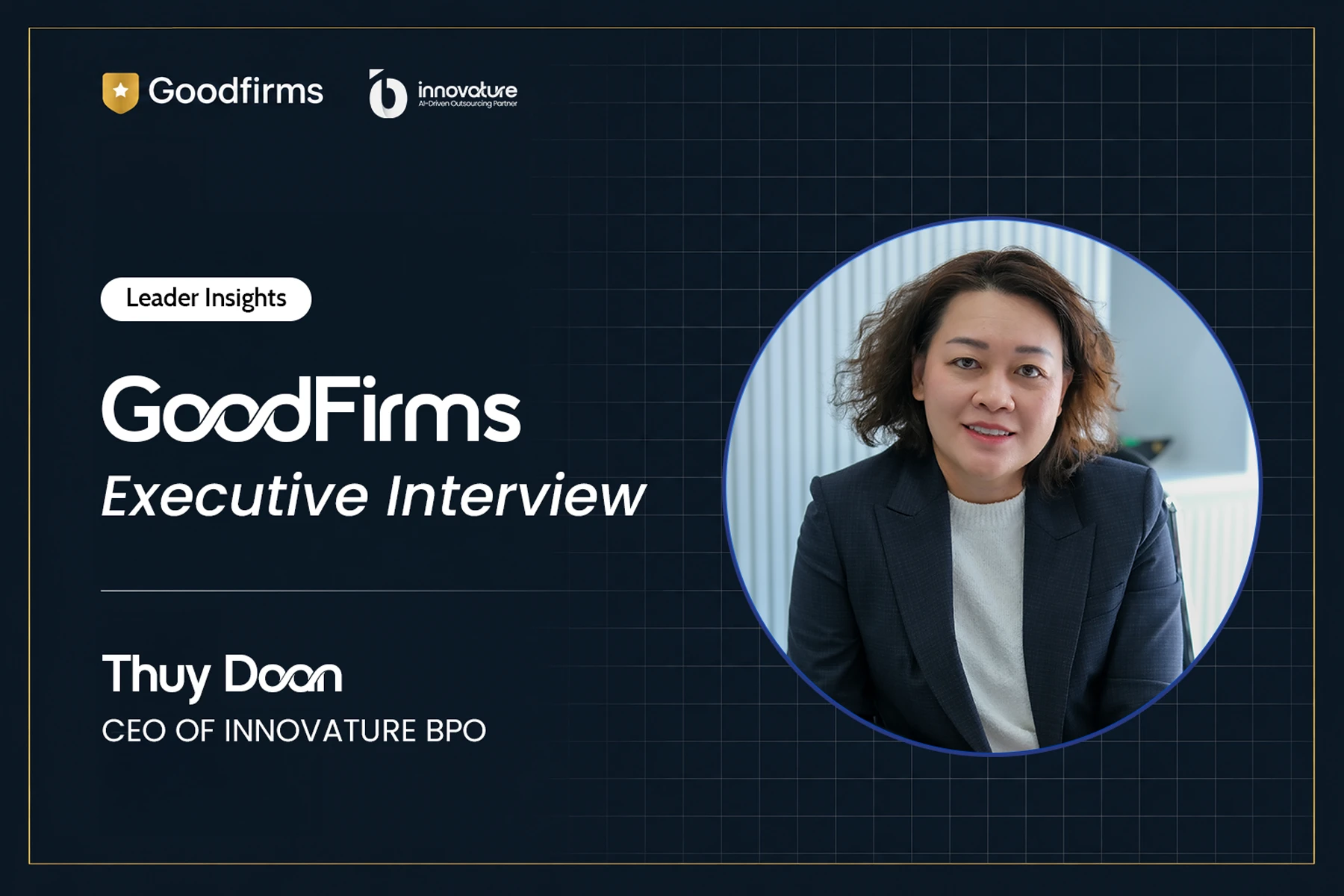
GoodFirms Interviews Innovature BPO CEO Thuy Doan
GoodFirms, the independent B2B research and review platform, has published an executive interview with Thuy Doan, CEO of Innovature BPO. In the conversation, she explains why outsourcing should be treated as a strategic capability rather than a cost-cutting exercise, and shares what ten years of building Vietnam-based teams for international clients have taught her about ownership, quality and long-term partnerships.
The interview covers the three metrics she would track to predict success, the trade-off between growth speed and service standards, why outsourcing projects fail, and how AI is changing the role of people in business process outsourcing. We are republishing the full interview below for clients, partners and anyone evaluating an offshore operating model.
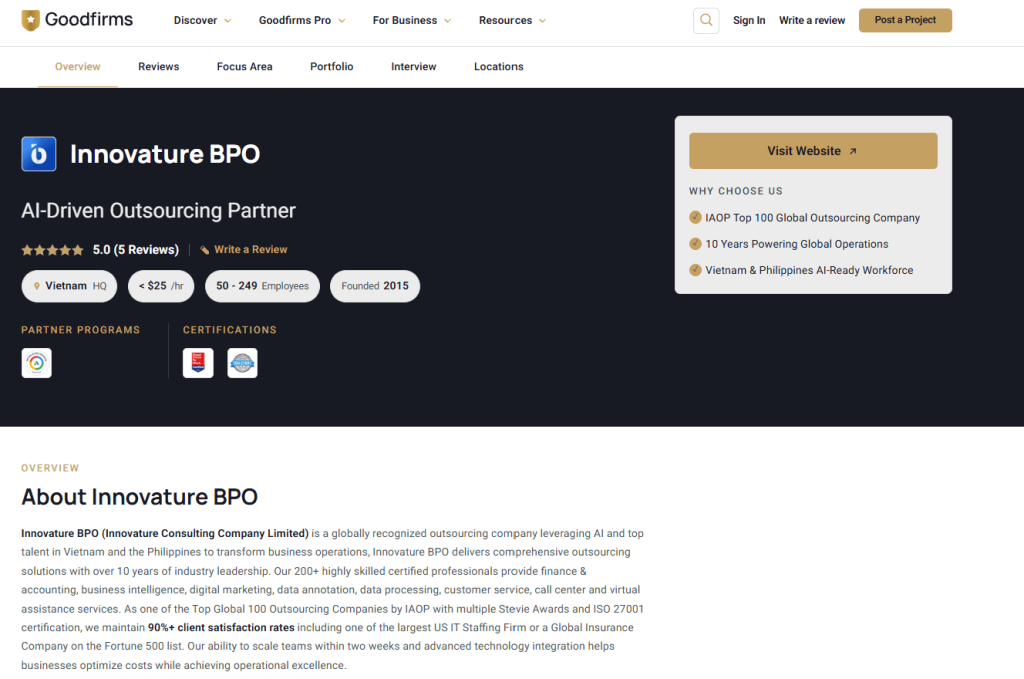
The Full Interview
1. What’s a piece of conventional wisdom in your industry that you think is completely wrong? What should companies do instead? And if you could only track three metrics to predict success, which would they be?
The belief I disagree with most is that outsourcing is mainly a way to save money. Cost matters, but companies that treat outsourcing as “the same people, cheaper” miss most of the value.
After ten years building Innovature, what I’ve seen work is different: the outsourced team becomes a real extension of the client’s business. So instead of asking how many people they can hire at a lower rate, companies should ask how they can build scalable operations with the right people, processes and technology behind them.
If I could track only three metrics:
- Client retention and expansion — are clients staying, and are they trusting us with more?
- Operational quality and productivity — are we hitting service standards while getting more efficient?
- Employee retention and development — are we building teams that can keep delivering?
They feed each other. Strong teams deliver better results, better results earn trust, and trust is what grows the business.
2. What problem did you set out to solve that others were overlooking? Was there a specific moment that convinced you it needed to be solved? And if you were starting from scratch today with no budget or brand, what would your first three moves be?
I came back to Vietnam after ten years studying and working in the United States, and the gap was obvious: Vietnamese professionals were far more capable than the international opportunities available to them.
The moment it became real was when my former employer started exploring an offshore team in Vietnam. I’d been thinking about starting a business but hadn’t found the right idea. That conversation was it — connect capable Vietnamese professionals with international companies that need reliable, high-quality operational support.
It was never about cheap staffing. I wanted to prove that Vietnamese talent could work at international standards and help global businesses grow.
Starting from scratch today, my first three moves would be: find one client with a clear operational problem I can solve, hire a small team of exceptional people, and deliver results strong enough to earn referrals.
3. What’s the toughest trade-off you’ve had to make between quality, speed, and cost? What did you sacrifice, and why was it the right decision?
In a people business, clients often want to scale fast, keep quality high and pay a competitive price — all at once. You can’t always deliver all three.
For us the hardest trade-off has been between growing quickly and protecting service standards. There were times when growing faster would have meant hiring people before we had the training, management capacity or quality controls to support them. I chose to give up some speed rather than compromise delivery.
But waiting for perfect operations before you grow is its own trade-off — clients don’t wait. So we separate what’s fixed from what keeps moving. Accuracy, information security and agreed service levels are non-negotiable from day one. Everything above that line is built to improve as we grow: procedures get updated every time a team handles an exception, cross-training means no client’s quality depends on one person, and repetitive work keeps shifting to automation and AI so our people focus on judgement. We measure all of it, so improvement is something we can show a client, not just claim.
The goal isn’t perfection before growth. It’s an organisation that gets better at quality as it scales.

4. From your experience, what’s the biggest reason projects fail? What happens when companies avoid that mistake? Have you uncovered any surprising patterns in your client data over the years?
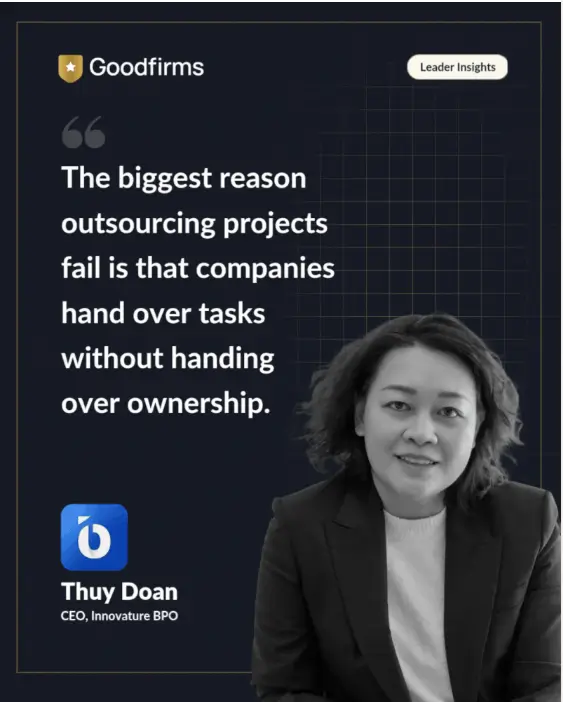
The biggest reason outsourcing projects fail is that companies hand over tasks without handing over ownership.
A client might give the offshore team a detailed list of responsibilities but say nothing about decision-making, performance measurement or communication. So the team follows instructions instead of taking responsibility for outcomes.
When ownership is clear from day one, everything changes. The offshore team becomes proactive, spots improvements and gradually takes on more complex work.
One pattern that surprised me: our best client relationships didn’t start big. Some of our strongest engagements began with very small teams and grew as we earned trust. The quality of the first engagement matters far more than its size.
5. What kind of results do clients typically see within the first year? And what separates your highest-performing clients from everyone else?
In the first year we aim for three things: cost efficiency, operational stability and the ability to scale.
The first few months are about recruitment, knowledge transfer, process documentation and setting performance standards. Once things are stable, we shift to improving productivity, removing bottlenecks and finding the next things worth outsourcing. For many clients, the real win is that their managers stop doing routine operational work and get their time back for higher-value things.
What separates our best clients is simple: they treat the offshore team as part of their company, not as a vendor. They invest in onboarding, share their business objectives and knowledge, and let offshore employees own their work.
Clients who bring us into operational planning also create far more room for improvement than clients who just assign tasks. The strongest relationships run on shared accountability, not transactions.
6. Can you walk us through one of your most challenging client transformations? What was the problem, what changed, and what outcomes did the client achieve?
One of our most meaningful engagements has been helping $1B U.S. staffing company build its offshore shared services operation.
The challenge wasn’t filling positions. The client needed an operating model that could support several business functions at once while keeping consistency, control and service quality.
We built and expanded a shared services operation covering accounting, HR, payroll and business analytics. The hard part was that every function had its own processes, stakeholders, compliance requirements and performance measures — and we needed a delivery structure that respected those differences while still running as one integrated team.
Over time our role grew from supplying individual people to supporting the whole shared services model, with dedicated functional expertise and management oversight.
The client ended up with an offshore operation spanning multiple functions, which let them consolidate activities and add operational capacity. For me, it shows how outsourcing can start as a staffing solution and become a long-term operational partnership.
7. What does your quality control process look like? Is there anything you would never compromise on, even if a client requested it? And how do you manage scope creep while maintaining a strong relationship?
Quality starts before we deliver anything.
We first get a clear picture of the client’s processes, expectations, KPIs and risks. From that we build recruitment criteria, training plans, standard operating procedures and the right quality controls. Once delivery starts, our management teams monitor performance, review quality and work with the client to fix issues and find improvements.
We also take information security seriously. Innovature holds ISO 27001 and ISO 27701 certifications.
Three things I will never compromise on: integrity, information security and treating our employees professionally.
On scope creep, the answer is transparency, not rigidity. Requirements evolve, especially in long relationships. We want our teams to be flexible and responsive — but when a change materially affects workload, responsibilities or service expectations, we put it on the table and discuss it openly. A strong relationship doesn’t mean saying yes to everything. It means finding solutions that work for both sides over the long run.

8. What does your ideal client look like in terms of mindset, readiness, and goals? On the other hand, are there any clients you would choose not to work with, and why?
Our ideal client sees outsourcing as a strategic capability, not just a way to cut headcount costs.
They don’t need perfectly documented processes or prior outsourcing experience — helping clients build structured operations is part of what we do. What they do need is clear business objectives, a willingness to collaborate and an understanding that a successful offshore team takes commitment from both sides.
I especially enjoy working with growing companies that need to build scalable operations, whether that’s dedicated offshore teams, managed services or a shared services centre.
Who we’d decline: clients whose expectations clash with our values. If someone wants extremely low pricing at the expense of employee welfare, or shortcuts that compromise information security or professional standards, we’d rather walk away. Choosing the right clients matters as much as winning new ones.
9. What capability are you investing in today that clients aren’t asking for yet but soon will be? And if AI automates a large portion of your industry, what human element will remain indispensable?
We’re investing in the move from traditional outsourcing to AI-enabled operations.
Most clients still start with “how many people do I need and what does each one cost?” I think that conversation will shift to “what outcome do I want, and what mix of people, process and technology gets me there?”
At Innovature we’re building AI-enabled services in areas like customer support and finance and accounting — automation combined with skilled professionals who handle exceptions, exercise judgement and keep improving the process. In accounting, for example, AI can process invoices, extract data and flag discrepancies, but you still need experienced accountants to deal with the exceptions, interpret the numbers and keep the controls sound.
I don’t think the future is replacing people with AI. It’s redefining what people are for. As routine work gets automated, critical thinking, judgement, problem-solving and relationship management become more valuable, not less. Our job as a BPO provider is to get our workforce ready for that now, not wait for clients to ask.
10. How has your presence on GoodFirms influenced the way potential clients discover or evaluate your company? And what has your overall experience with GoodFirms been like?
In outsourcing, trust decides deals. Clients are handing over critical functions, sensitive data and long-term operational responsibility, so they need to be sure about who they’re working with.
GoodFirms gives potential clients another way to find providers, compare capabilities and check credibility. For Innovature, being on an independent review platform supports the wider work we’re doing to build international brand recognition.
Reviews and independent assessments matter because prospects want to know not just what a provider promises, but what existing clients have actually experienced.
As we expand internationally, particularly in Europe and Asia-Pacific, platforms like GoodFirms help us reach companies that don’t yet know Innovature — or what Vietnam’s outsourcing industry can do. Our goal is the same wherever a client finds us: long-term relationships built on consistent delivery, transparency and measurable value.
Building Long-Term Outsourcing Partnerships

The principles Thuy Doan describes are the ones Innovature applies in every engagement: start with a clear operational problem, give offshore teams real ownership, protect information security from day one, and keep improving as the operation scales. Since 2015, that approach has helped international companies build dedicated teams, managed services and shared services operations in Vietnam. Read more about Innovature’s 10-year journey and how we protect client data in outsourcing.
If you are planning to build or scale an offshore team, explore Innovature’s outsourcing solutions or contact Innovature BPO to discuss your operating model.
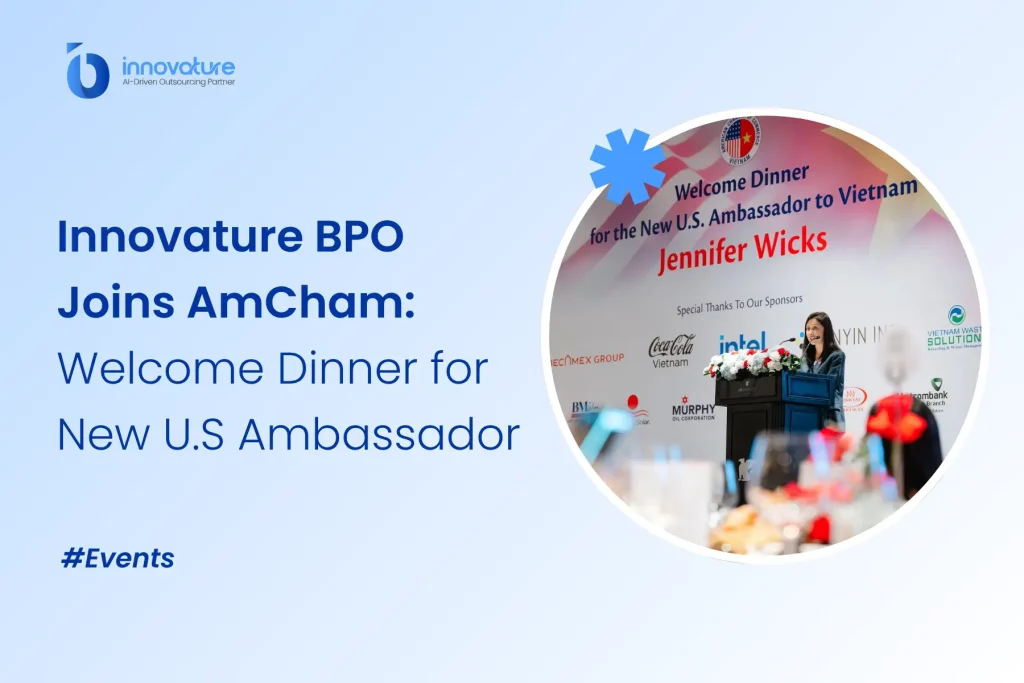
On October 1, 2026, Innovature BPO joined AmCham Vietnam and members of the American business community in Ho…

Most companies now agree that AI can improve operations. The harder question is where it creates measurable business…

CEO of Innovature BPO – Ms. Thuy, was honored to participate in the Vietnam Financial Forum (VFF) 2026,…

As a leader in the global market, Innovature BPO continually seeks to empower small and medium-sized enterprises (SMEs)…

Innovature BPO is proud to announce its participation in the 28th Annual Shared Services & Outsourcing Week (SSOW)…

Chicago – Innovature BPO is proud to announce our participation in OWS25 – the flagship global outsourcing conference hosted…

Innovature BPO took networking to the next level with a special VIP event held at Top Golf Orlando.…

Innovature BPO had the opportunity to attend the Shared Services and Outsourcing Week (SSOW) 2025 in Orlando, Florida,…

Innovature BPO is proud to sponsor the Shared Services and GBS Select Leadership Summit 2025, the premier invitation-only…

Innovature BPO, award-winning provider of Business Process Outsourcing (BPO) solutions, is excited to announce our participation in the…

Spanning over 4 days, SSOW 2024 has become the most significant and worthy event where 1000+ attendees, 150+…

Following an incredible trajectory of industry growth, the ultimate event for finance professionals—the Accounting Business Expo 2026—recently concluded…
Ready to move faster?
Trust us to find the best-fit candidates while you concentrate on building a skilled and diverse remote team.