
Where AI Actually Pays: 3 Questions Before You Automate
Last updated:
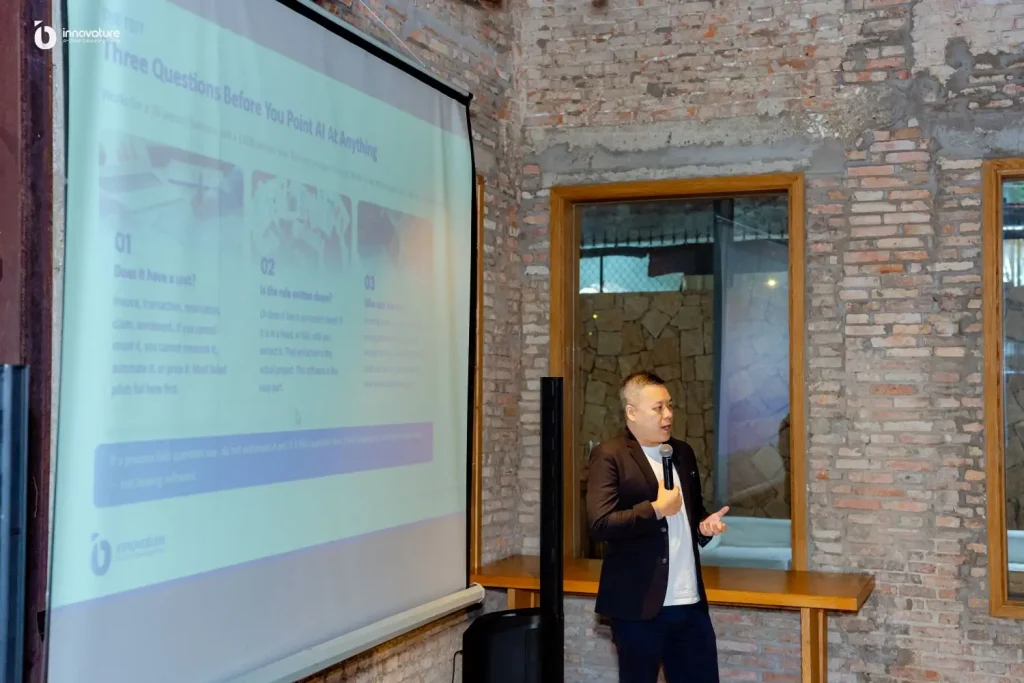
Most companies now agree that AI can improve operations. The harder question is where it creates measurable business value first. At AusCham Vietnam’s executive workshop on AI and customer experience, Innovature BPO COO Quang Doan argued that the answer often sits in the back office, and that every automation decision should start with three questions about the business problem, the outcome and the role of people.
Why the Back Office Is Where AI Actually Pays
For many organizations, the challenge is no longer recognizing AI’s potential. It is deciding which processes to improve first, how automation fits into existing workflows, and what measurable outcomes justify the investment.
Back-office operations such as finance and accounting, data processing and service operations are where these questions are easiest to answer. The work is process-driven, the bottlenecks can be identified, and results can be measured in accuracy, turnaround time and capacity.
That was the focus of Mr. Quang Doan’s session, “The Back Office Is Where AI Actually Pays – Three Questions to Ask Before You Automate Anything.” Rather than starting with emerging technologies, he approached AI adoption from an operational perspective: understand the business problem, clarify process ownership and define success criteria before choosing a tool.
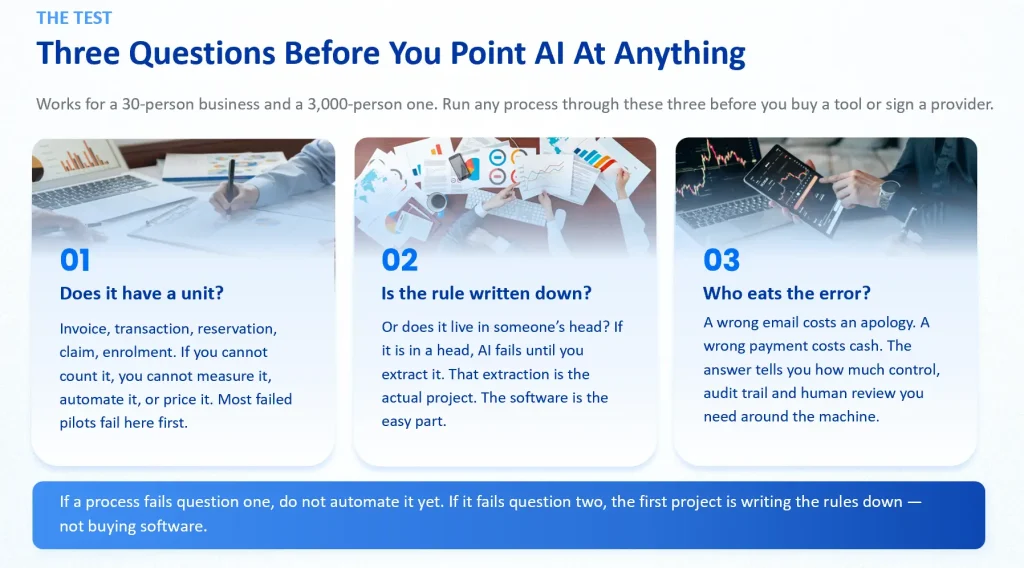
3 Questions to Ask Before You Automate Anything
1. Does it have a unit?
Invoices, transactions, reservations, claims and enrolments are all countable units. If you cannot count a process, you cannot measure it, automate it or price it. Most failed pilots fail here first. If a process fails this question, do not automate it yet.
2. Is the rule written down?
Or does it live in someone’s head? If it does, AI will fail until the rule is extracted and documented. That extraction is the actual project; the software is the easy part. If a process fails this question, the first project is writing the rules down, not buying software.
3. Who eats the error?
A wrong email costs an apology. A wrong payment costs cash. The answer tells you how much control, audit trail and human review you need around the machine.
Worked Example: Accounts Payable
Accounts payable is the one process every business has: invoices arriving from suppliers who will not change how they send them. It is the process most organizations should automate first, and the one most often attempted without ever answering question two.
- Unit: the invoice. AP is countable, priceable and measurable, so it passes question one cleanly. That is rare, and it is why AP is the right first process.
- Rule: rarely written. Approval thresholds, GL codes for ambiguous spend, which entity carries the cost and what counts as a valid exception all need to be standardized. That is the real work.
- Error: cash leaves. Duplicate payments, wrong vendors and changed bank details cost money and are hard to reverse. The control layer is not optional. Learn more about vendor master data controls for AP.

Better Customer Experience Starts Behind the Scenes

Customer experience is usually associated with contact centers, digital support channels and service automation. Yet the quality of those interactions depends on the operational processes behind them.
Information accuracy, internal workflows, approval processes and timely access to business data all affect how well customer-facing teams respond. An AI-powered customer service tool may improve response availability, but resolving complex requests still depends on accurate records, clear escalation procedures and coordinated back-office operations.
The takeaway for business leaders: improving customer experience requires investment in both front-office interactions and the operational systems that support them.
How Innovature Applies This in AI-Enabled Outsourcing
This operational view shapes how Innovature BPO delivers services across Customer Experience, Finance and Accounting, and Data and Analytics. Technology, operational expertise and structured delivery work together, so automation is assessed in the context of business performance rather than treated as a standalone initiative.
In practice, that means combining automation with skilled professionals who handle exceptions, exercise judgment and keep improving the process. Clients gain efficiency from technology while keeping the accountability and quality control that only experienced teams provide.
Insights Shared at AusCham’s AI & CX Workshop
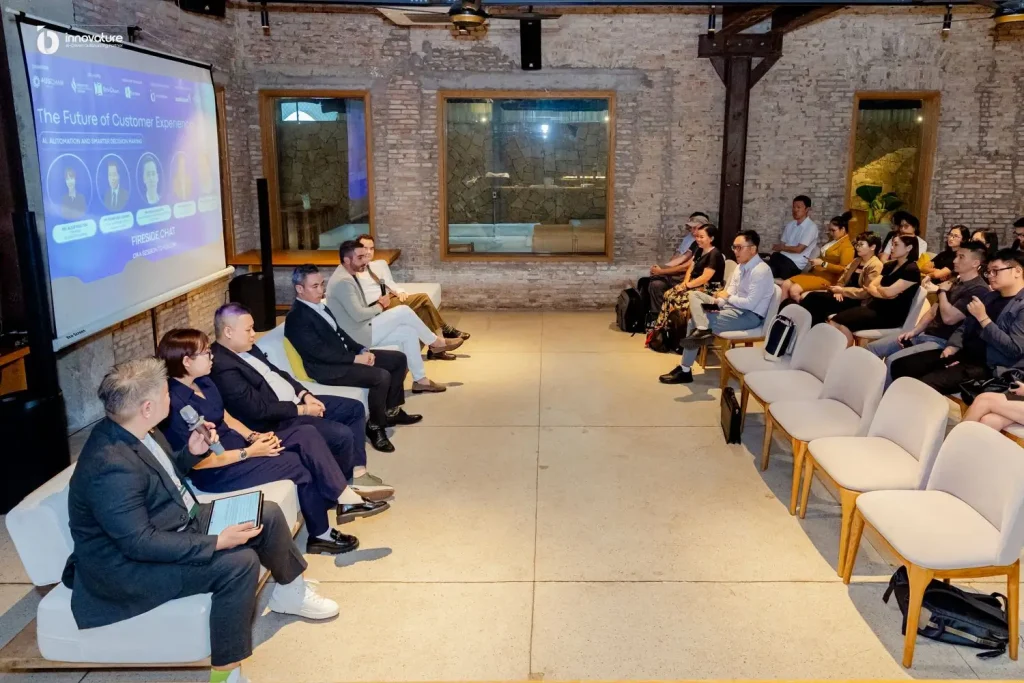
The session was part of the AusCham executive workshop “The Future of Customer Experience: AI, Automation & Smarter Decision Making”, held on October 1, 2026, in Ho Chi Minh City. Organized by the Australian Chamber of Commerce Vietnam, the event brought together business leaders, technology specialists and industry professionals, with speakers from consulting, technology and business operations.
Mr. Quang Doan brings more than 15 years of experience in digital transformation and business intelligence. At Innovature BPO, he oversees solution architecture, technology deployment and service delivery governance.
As an AusCham Corporate Member, Innovature values conversations that connect business challenges with practical operational solutions. We thank AusCham for organizing the event, and the speakers and attendees who contributed to the discussion.
Planning where AI fits in your operations? Explore Innovature’s Customer Experience Outsourcing Services, learn more about Innovature BPO, or contact our team to discuss which processes to automate first.

On October 1, 2026, Innovature BPO joined AmCham Vietnam and members of the American business community in Ho…
GoodFirms Interviews Innovature BPO CEO Thuy Doan GoodFirms, the independent B2B research and review platform, has published an…

CEO of Innovature BPO – Ms. Thuy, was honored to participate in the Vietnam Financial Forum (VFF) 2026,…

As a leader in the global market, Innovature BPO continually seeks to empower small and medium-sized enterprises (SMEs)…

Innovature BPO is proud to announce its participation in the 28th Annual Shared Services & Outsourcing Week (SSOW)…

Chicago – Innovature BPO is proud to announce our participation in OWS25 – the flagship global outsourcing conference hosted…

Innovature BPO took networking to the next level with a special VIP event held at Top Golf Orlando.…

Innovature BPO had the opportunity to attend the Shared Services and Outsourcing Week (SSOW) 2025 in Orlando, Florida,…

Innovature BPO is proud to sponsor the Shared Services and GBS Select Leadership Summit 2025, the premier invitation-only…

Innovature BPO, award-winning provider of Business Process Outsourcing (BPO) solutions, is excited to announce our participation in the…

Spanning over 4 days, SSOW 2024 has become the most significant and worthy event where 1000+ attendees, 150+…

Following an incredible trajectory of industry growth, the ultimate event for finance professionals—the Accounting Business Expo 2026—recently concluded…
Ready to move faster?
Trust us to find the best-fit candidates while you concentrate on building a skilled and diverse remote team.