

Finance outsourcing governance is a framework that defines roles, decision rights, internal controls, and provider oversight when finance activities are outsourced. It aligns RACI, Segregation of Duties (SoD), Role-Based Access Control (RBAC), approval workflows, reconciliations, and SLA/KPI monitoring. The provider performs the agreed service scope, while the client typically retains governance, key decision rights, and accountability for financial outcomes.
Why Finance Outsourcing Governance is Non-Negotiable
Outsourcing moves finance activities to a BPO provider, but it does not move financial accountability with them. The client still needs to control who can access data, approve transactions, review results, and resolve exceptions.
The challenge increases when finance activities are distributed across internal teams, offshore delivery centers, ERP platforms, and approval workflows. Without clear governance, the business can face four practical control gaps: unauthorized access, unclear approval authority, insufficient review of financial activity, and unclear ownership when issues occur.
Gartner’s 2024 survey of CFOs and finance leaders identified enterprise data quality as a significant concern for 2025, with 14% of respondents citing it as a key challenge. In an outsourced finance model, clear data ownership, access controls, review procedures, and reconciliations help maintain reliable financial information.
Deloitte’s 2024 Global Outsourcing Survey shows that governance remains important as outsourcing models evolve. Among more than 500 executives surveyed, 70% said their traditional Vendor Management Office (VMO) was not fully mature, while 80% planned to maintain or increase investment in third-party outsourcing. At the same time, 70% had brought some previously outsourced scope back in-house during the prior five years. This shows that the client-provider operating model can change over time, so roles, decision rights, and controls need to remain clearly defined.
A finance outsourcing governance model should therefore make four areas clear:
- Access: Who can view or change financial data?
- Authority: Who can approve transactions and make decisions?
- Review: Who checks reconciliations, transactions, and reports?
- Accountability: Who remains responsible for financial outcomes and control effectiveness?
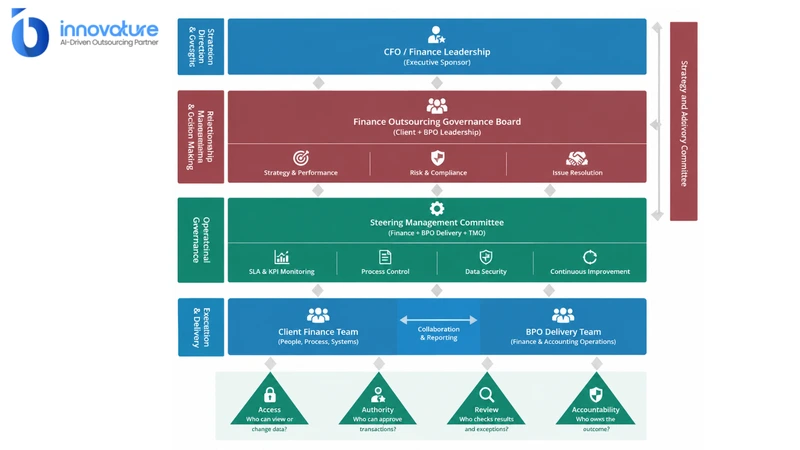
Outsourcing transfers execution, not accountability. Governance gives the client the structure needed to maintain visibility and control while day-to-day finance operations are delivered by the BPO provider.
Defining Key Roles in the Finance Governance Model
A finance outsourcing governance model works only when responsibilities and decision rights are clearly separated. A well-designed outsourced finance RACI framework clarifies who performs each activity, who owns the outcome, and who has decision authority. This distinction matters because the person processing a transaction is not necessarily the person who should approve it or own the financial outcome.

The Retained Organization
The retained organization is the client’s internal finance function that remains accountable for the outsourced operation. These retained finance responsibilities typically include financial policy ownership, approval authority, risk management, reporting oversight, and control effectiveness. It does not need to perform routine transactions itself. Instead, it keeps the responsibilities that require financial authority, business judgment, and risk ownership.
Its core responsibilities typically include:
- Setting accounting policies and control requirements
- Retaining financial and risk accountability
- Approving material transactions and exceptions
- Owning control design and financial reporting sign-off
- Managing key business and finance stakeholders
- Making escalation and scope decisions
A practical RACI model might define responsibilities as follows:
| Finance Process | Execute | Review | Approve | Own Outcome |
| AP invoice processing | BPO Finance Analyst | BPO Team Lead | Client AP Manager | Client Finance Owner |
| Payment preparation | BPO Finance Analyst | BPO Team Lead | Client Authorized Approver | Client Finance Controller |
| AR cash application | BPO Finance Analyst | BPO Team Lead | Client AR Manager | Client Finance Owner |
| GL journal preparation | BPO Accountant | Finance Reviewer | Client Controller | Finance Leadership |
| Month-end close activities | BPO Close Team | Client Finance Reviewer | Controller | CFO / Finance Leadership |
| Financial reporting | BPO Reporting Team | Client Finance Team | Finance Director | CFO |
| Payroll processing | BPO Payroll Team | Client HR/Finance Reviewer | Authorized Client Approver | Client Management |
This RACI is an illustrative governance model rather than a universal authority structure. Approval and accountability should be adapted to transaction materiality, entity structure, regulatory requirements, system design, and the client’s Delegation of Authority. For example, a BPO team may prepare a journal entry or payment file, while approval remains with an authorized client role.
Specific finance processes such as Accounts Receivable outsourcing require clear ownership models because activities like cash application, reconciliation, and customer account management involve both operational execution and financial accountability.
The key distinction is Accountability ≠ Authority ≠ Execution. Clearly defining retained finance responsibilities prevents approval ownership, operational execution, and financial accountability from becoming unclear between the client and the BPO provider.
This model also allows the retained finance team to focus internal expertise on higher-value work. Understanding finance outsourcing cost considerations also requires evaluating retained responsibilities, governance effort, transition requirements, and the operating model beyond the provider fee.
Robert Half’s 2024 Demand for Skilled Talent research found that 87% of finance and accounting hiring managers surveyed had difficulty finding skilled talent, with FP&A, AP/AR, bookkeeping, and financial reporting among the areas facing staffing challenges. This supports a clear division of labor: retain judgment-intensive responsibilities internally while using the BPO team to scale standardized finance execution.
The BPO Delivery Team
The BPO delivery team is responsible for day-to-day execution within the agreed scope, controls, and service levels. It should be structured as a delivery function rather than treated as a group of outsourced accountants.
A typical structure includes:
- Delivery or Account Manager: overall service performance, governance coordination, and escalation
- Process Manager: process ownership, quality, capacity, and continuous improvement
- Team Lead / SME: operational supervision, complex cases, and issue resolution
- Finance Analysts / Accountants: transaction processing, reconciliations, reporting preparation, and exception handling
- Quality or Control Support: quality checks, control testing, and evidence management where required
Typical responsibilities include:
- Transaction and invoice processing
- AP/AR operations
- Journal preparation
- Account reconciliation
- Management and financial reporting preparation
- Exception management
- SOP adherence and process documentation
- SLA delivery and issue escalation
The BPO team can prepare, process, reconcile, and recommend, but material approval authority should remain with the designated client role unless it has been explicitly delegated through the agreed governance and authority framework.
This also reflects how the F&A BPO market is evolving. Gartner reported in its 2024 Magic Quadrant for Finance and Accounting BPO that more than a third of outsourcing contracts included technology and transformation expertise for core F&A operations. This means the BPO role increasingly extends beyond transaction processing to process improvement, automation, reporting, and transformation support.
The Joint Governance Board and TMO
The Transition Management Office (TMO) and the Governance Board serve different purposes and should not be treated as the same function.
The TMO is transition-focused. It establishes and validates the new operating model before BAU. Its work typically covers:
- Knowledge transfer and process validation
- SOP and control validation
- Test cases and UAT
- Data migration and reconciliation
- Parallel run
- Cutover readiness
- Stabilization and hypercare
- BAU handover
The Governance Board is BAU-focused. Once the service is stabilized, it oversees the relationship and makes decisions on performance, risk, and changes. Its responsibilities typically include:
- SLA and KPI performance
- Service quality and recurring issues
- Control exceptions and operational risk
- Escalations and remediation
- Scope or service changes
- Continuous improvement
- Automation and transformation priorities
- Contract or commercial changes
The operating cadence should match the lifecycle rather than follow a fixed meeting schedule. Transition may require frequent operational checkpoints; BAU can use regular service reviews, monthly SLA/KPI governance, and periodic strategic or control reviews based on risk and complexity.
The governance model should ultimately follow this lifecycle:
Transition → Parallel Run → Stabilization → BAU → Continuous Improvement
| Transition Management Office | Governance Board | |
|---|---|---|
| Primary stage | Transition and stabilization | BAU |
| Primary objective | Establish and validate the operating model | Sustain and improve the operating model |
| Typical focus | Knowledge transfer, SOPs, UAT, migration, parallel run | SLA/KPI, risk, controls, escalations, improvements |
| Key output | BAU readiness | Performance and governance decisions |
| Typical cadence | Frequent during transition | Regular operational, monthly and periodic reviews |
A useful rule is: the TMO establishes and validates the operating model; the Governance Board sustains and improves it after transition.
Essential Internal Controls in Finance Outsourcing Governance
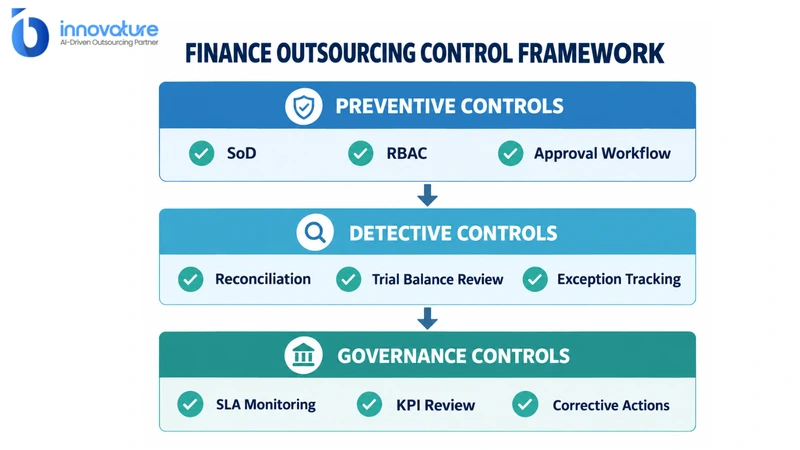
When finance activities are outsourced, effective finance outsourcing controls help prevent errors, identify issues, and monitor the BPO provider’s performance while maintaining financial accountability. A practical governance model can organize these controls into three areas:
| Control Area | Main Purpose | Typical Controls |
| Preventive | Stop errors or unauthorized activity before processing | SoD, RBAC, approval workflows, least privilege |
| Detective | Identify errors or exceptions after processing | Reconciliation, trial balance review, exception tracking |
| Governance | Monitor service performance and control effectiveness | SLA, KPI, service reviews, corrective actions |
Preventive Controls: Enforcing Segregation of Duties (SoD) & RBAC
Preventive controls are the first line of protection. In an outsourced finance process, Segregation of Duties (SoD) and Role-Based Access Control (RBAC) help ensure that no single user has excessive control over a high-risk transaction.
For example:
Invoice preparation → Review → Payment approval → Payment release
A BPO team member may prepare the invoice or payment, while the designated client role retains approval authority. RBAC then limits each user to the system permissions required for their role.
Key controls include:
- Least-privilege access
- Maker-checker approval
- Approval hierarchy
- Delegation of Authority
- Periodic access review
Access should also be reviewed when employees join, change roles, or leave:
Joiner → Mover → Leaver → Periodic Review
Automation does not remove the need for these controls. Deloitte’s 2024 Global Outsourcing Survey found that 83% of surveyed executives were using AI in outsourced services, while only 20% were developing strategies to manage digital workers. Deloitte identified governance and contracting challenges as a factor limiting the tangible benefits of AI-powered outsourcing.
For high-risk or judgment-intensive activities, a human approval or exception step can therefore provide an additional control over automated execution.
The same principle should apply when automation or AI performs part of the workflow. The governance model should define what the system can execute automatically, which exceptions require human review, who can override an automated decision, and what evidence is retained. Automation can change how a control operates, but it does not eliminate the need for defined authority and traceable review.
Detective Controls: Independent Reconciliation & Trial Balance Review
Preventive controls reduce the chance of a problem. Detective controls check whether a problem has already occurred.
Reconciliation is one of the most important detective controls in outsourced finance because it compares accounting records with independent source data.
Common reviews include:
- Bank-to-GL
- AP-to-GL and AR-to-GL
- Subledger-to-GL
- Intercompany
- Payroll-to-GL
- Fixed assets
- Tax and suspense accounts
- Trial balance
The basic control flow is:
Preparer → Reviewer → Exception → Resolution → Evidence
A reconciliation is not complete simply because a file has been prepared. The control is complete when the designated reviewer has assessed the reconciliation, material differences have been investigated, unresolved items have an owner and due date, and sufficient evidence has been retained. This distinction becomes especially important when preparation is outsourced but review authority remains with the client.
APQC reports a 95% median for first-time error-free disbursements across 2,479 organizations. This can provide an external benchmark for setting performance expectations, but it should not automatically become an SLA for an outsourced finance process.
Governance Controls: Vendor SLA & KPI Performance Monitoring
The first two control groups focus on transactions. Governance controls focus on whether the outsourced service is operating as agreed.
The distinction between KPI and SLA should be clear:
KPI measures performance. SLA defines the contractual service commitment.
A practical KPI framework can include:
| Dimension | Example KPI |
| Accuracy | First-time error-free transactions |
| Timeliness | Close cycle time |
| Control | Overdue reconciliations |
| Service | SLA attainment |
| Issue management | Open issue aging |
| Quality | Repeat incidents |
Performance management should follow:
Benchmark → Baseline → Target → SLA → Continuous Improvement
The benchmark provides an external reference. The baseline shows current performance, the target defines the expected level, and the SLA converts agreed requirements into measurable service commitments. Governance then uses KPI results and exceptions to identify corrective actions and improvement opportunities.
This gives the client visibility into more than whether the BPO team completes work on time. It shows whether the service is accurate, controlled, and improving over time.
The Finance Outsourcing Governance Control Matrix
A control matrix turns finance outsourcing governance into an operating tool by documenting key finance outsourcing controls, ownership, evidence requirements, and remediation processes. Instead of simply stating that controls are monitored, it shows what can go wrong, which control addresses the risk, who owns it, how often it is performed, and what evidence supports the control.
| Process | Risk | Control | Owner | Frequency | Evidence |
| Vendor master | Unauthorized vendor | Approval + SoD | Client | Per change | Approval log |
| AP | Duplicate or incorrect payment | 3-way match + approval | BPO / Client | Per transaction | ERP record |
| Bank reconciliation | Unidentified differences | Independent reconciliation | BPO / Client | Monthly | Reconciliation file |
| Journal entry | Unauthorized posting | JE approval workflow | Client | Per JE | JE approval |
| Access | Excessive access | RBAC review | Client IT / Finance | Quarterly | Access review |
| SLA | Service deterioration | KPI dashboard | Governance Board | Monthly | SLA report |
The matrix should not stop at monitoring. When a control exception is identified, the governance process should record the exception, root cause, remediation owner, corrective action, and target completion date. This creates a clear path from Risk → Control → Evidence → Exception → Remediation and gives the client a documented basis for follow-up, audit, and continuous improvement.
What Happens When a Finance Control Fails?
A governance framework should define not only how controls operate, but also what happens when a control fails. An overdue reconciliation, unauthorized access event, duplicate payment, or missed SLA should trigger a documented response rather than remain only as a dashboard exception.
Exception Detected → Assess Severity → Contain Risk → Assign Owner → Identify Root Cause → Correct → Validate Evidence → Close
The response should reflect the severity and financial impact of the exception. A routine processing error may be resolved through operational correction, while a material control failure may require escalation to the client controller, risk owner, or Governance Board.
Recurring exceptions should also be analyzed separately from isolated incidents. If the same reconciliation issue, approval failure, or SLA miss continues to occur, governance should address the underlying process, staffing, system, or control-design issue rather than repeatedly correcting individual cases.
| Exception Question | Governance Requirement |
|---|---|
| What happened? | Document the exception |
| How material is it? | Assess financial and control impact |
| Who owns resolution? | Assign a named owner |
| Why did it happen? | Complete root-cause analysis |
| What needs to change? | Define corrective action |
| How do we know it is fixed? | Retain closure evidence |
| Could it happen again? | Review control or process design |
Five Questions to Answer Before Finance Operations Move to BAU
Before transition is considered complete, finance leaders should be able to answer five governance questions clearly:
- Who can execute each material finance activity?
- Who has authority to approve transactions and exceptions?
- Who independently reviews the work and control evidence?
- What evidence demonstrates that each key control operated?
- Who owns escalation and remediation when a control fails?
If any answer is unclear, the operating model may be technically ready to process transactions but not yet ready to operate under effective governance.
How Finance Governance Works in Practice at Innovature BPO
Innovature BPO manages Finance & Accounting Services through a governance model designed to keep responsibilities clear, controls consistent, and finance operations visible to the client. For CFOs and finance leaders, this governance approach provides visibility into outsourced operations without requiring them to rebuild an internal finance delivery structure. The approach combines four practical control layers:
- Information security: Finance delivery is supported by ISO/IEC 27001:2022 and ISO/IEC 27701 controls, defined access requirements, and secure IT environments.
- Delivery governance: Defined delivery, review, QA, escalation, and backup roles support accountability and service continuity.
- Process controls: Process mapping, SOPs, training, system testing, reconciliations, and documented workflows establish consistent execution before BAU.
- Performance governance: KPI/SLA monitoring, exception tracking, corrective actions, and service reviews provide visibility into performance and recurring risks.
These controls are reflected in Innovature’s client engagements. This finance outsourcing case study shows how structured roles, reconciliation processes, and control checkpoints helped stabilize finance operations during an ERP transition. For a US$1 billion IT staffing and managed services firm, Innovature established a Shared Service Center across Vietnam and the Philippines, with accounting, QA, audit, and backup roles. The engagement reached 90% SLA adherence after six months and 97% after twelve months, with full go-live in three months.
In another engagement, a fast-growing FDI manufacturer in Vietnam needed to stabilize finance operations during a live Microsoft Dynamics 365 transition. Innovature rebuilt the invoice baseline through reconciliation, document review, and control checkpoints, achieving 100% invoice posting completion, up from 86%, after reviewing approximately 800 invoices and identifying more than 100 previously unrecorded invoices.
Together, these engagements show how Innovature embeds governance into security, people, processes, technology, and performance management throughout the outsourcing lifecycle. For businesses looking to strengthen control over outsourced finance operations, Innovature can support the design and delivery of a model aligned with their roles, controls, performance requirements, and transition needs.
Building or reviewing an outsourced finance operating model? Innovature BPO can help define delivery roles, transition controls, governance checkpoints, and performance measures around your finance requirements. Contact our team to discuss your operating model.
Frequently Asked Questions
What is finance outsourcing governance?
Finance outsourcing governance is the framework used to define roles, decision rights, controls, provider oversight, and performance management when finance activities are delivered by an external provider.
Who remains accountable when finance activities are outsourced?
Outsourcing changes who performs the work, but it does not automatically transfer the client’s financial governance responsibilities. The exact division of execution, approval authority, control ownership, and accountability should be defined through the contract, RACI, Delegation of Authority, control framework, and applicable regulatory requirements.
What internal controls are needed in finance outsourcing?
Core controls include Segregation of Duties (SoD), RBAC, approval workflows, reconciliations, access reviews, exception management, SLA/KPI monitoring, and appropriate control evidence.
How do you enforce Segregation of Duties in an outsourced finance model?
Define roles, apply RBAC and least privilege, separate preparation from approval, use maker-checker controls, review access periodically, and monitor exceptions.
What are the essential KPIs to track for outsourced accounting teams?
Key measures typically cover accuracy, timeliness, control effectiveness, SLA attainment, issue resolution, service quality, and continuous improvement.
How often should finance outsourcing governance be reviewed?
Operational issues may be reviewed weekly or as needed, SLA/KPI performance monthly, risk and controls quarterly, and the broader governance framework annually or after material changes.


Finance leaders are under pressure to strengthen controls, close faster, improve data quality, and support business decisions without…

Vendor master data controls govern how supplier records are created, verified, approved, changed, and deactivated before they are…

Accounts receivable aging analysis helps finance teams evaluate unpaid customer invoices, identify overdue exposure, and decide which balances…
Selecting a finance outsourcing provider does not make a finance process ready to move. Before operational ownership changes…

PayrollOrg’s 2025 survey found that 38% of organizations do not track payroll performance, showing that payroll oversight remains…
Payroll accuracy often breaks down before payment is even made. PayrollOrg’s 2025 global survey identified poor-quality input data,…
Intercompany balances become harder to control as businesses add legal entities, currencies, systems, and cross-border transactions. A single…

An accounting quality control checklist helps Controllers and Finance Managers verify whether bookkeeping data is accurate, supported, and…

Month-end close often becomes harder as growing companies process more invoices, payments, reconciliations, and reporting requirements. Without a…

Accounts payable journal entries record what a business owes suppliers and how those obligations change over time. A…

Financial statements analysis is the process of examining a company’s income statement, balance sheet, and cash flow statement…

An offshore accounting strategy defines which finance work should move offshore, how that work will be delivered, who…
Ready to move faster?
Trust us to find the best-fit candidates while you concentrate on building a skilled and diverse remote team.