
Selecting a finance outsourcing provider does not make a finance process ready to move. Before operational ownership changes hands, the client and provider need to transfer process knowledge, validate system access, test controls, reconcile outputs, and agree on what “ready” means.
This guide provides a practical finance outsourcing transition plan built around a 90-day framework. It covers migration sequencing, knowledge transfer, parallel processing, stage gates, go-live readiness, and BAU handover — with the controls and deliverables finance leaders should validate at each stage.
What a Finance Outsourcing Transition Plan Should Cover
A finance outsourcing transition plan defines how finance activities, process knowledge, systems, controls, and operational responsibilities will move from the client team to the outsourcing provider. This process is a critical part of implementing effective finance and accounting outsourcing models. The goal is to transfer processes, knowledge, and responsibilities without disrupting day-to-day finance operations.
Before the transition begins, both sides should agree on:
- Scope: What finance activities, entities, and transaction volumes are being transferred?
- Processes: How are the activities performed today, and how will they operate after the transition?
- People: Which client SMEs, retained finance staff, and provider teams will be involved?
- Technology and controls: What systems, user access, approval workflows, reconciliations, and other controls are required?
- Governance: Who makes decisions, handles escalations, tracks progress, and signs off each transition stage?

As sourcing models become more complex, strong governance and management capabilities become increasingly important. Deloitte’s 2024 Global Outsourcing Survey highlights the need for organizations to strengthen how they govern and manage an extended workforce ecosystem, particularly as multiple sourcing models and providers become part of the operating model.
A well-defined governance structure helps both sides understand who is responsible for key decisions, how issues should be escalated, and what needs to be completed before each transition stage is signed off.
Decide What Moves First: Sequence Finance Processes by Risk
Not every finance process needs to move at the same time. Before setting the transition schedule, determine which activities can move together and which require additional validation because of financial, regulatory, or stakeholder risk.
| Process | What to Assess Before Transition |
|---|---|
| Accounts Payable | Invoice volumes, approval workflows, payment schedules, vendor dependencies, and exception rates |
| Accounts Receivable | Billing cycles, cash application, collections ownership, customer communication, and dispute handling |
| General Ledger | Close calendar, reconciliations, journal approvals, intercompany dependencies, and judgment-heavy entries |
| Financial Reporting | Data sources, reporting definitions, consolidation dependencies, and stakeholder deadlines |
| Payroll | Payroll cut-offs, employee data, approvals, statutory requirements, and escalation procedures |
| Tax & Compliance | Filing deadlines, jurisdiction requirements, documentation, review responsibilities, and regulatory accountability |
A phased migration can reduce transition risk when processes have different levels of complexity or dependency. The transition sequence should reflect operational readiness rather than moving every activity on the same date.
The 90-Day Finance Outsourcing Transition Roadmap
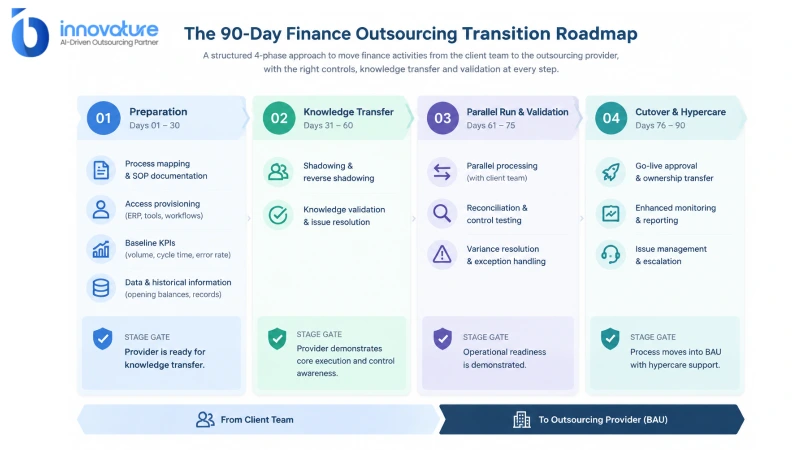
A 90-day transition provides a practical framework for finance outsourcing implementation, moving finance activities from the client team to the outsourcing provider. The timeline is not a fixed deadline. For finance operations, the parallel-run period may also need to cover one or more complete transaction or month-end cycles before operational ownership is transferred.
| Phase | Timeline | Main Activities | Stage Gate | Phase Outcome |
|---|---|---|---|---|
| Preparation | Days 01–30 | Process mapping, SOP documentation, access provisioning, baseline KPIs | Scope confirmed, critical SOPs documented, required access identified, baseline established | Provider is ready to begin structured knowledge transfer |
| Knowledge Transfer | Days 31–60 | Shadowing, reverse shadowing, knowledge validation, issue resolution | Provider demonstrates core process execution, control awareness, and exception handling | Provider is ready to enter controlled parallel processing |
| Parallel Run & Validation | Days 61–75 | Parallel processing, reconciliation, control testing, variance resolution | Outputs reconcile within agreed criteria and critical process/control gaps are resolved | Operational readiness is demonstrated |
| Cutover & Hypercare | Days 76–90 | Go-live approval, ownership transfer, enhanced monitoring, issue escalation | Go-live criteria are approved and no critical unresolved issue prevents handover | Process moves into BAU with defined hypercare support |
Days 01–30: Preparation
The first 30 days establish the foundation for the finance outsourcing transition. Both teams confirm the scope, map current processes, review SOPs, provision required system access, establish baseline performance, and identify the data and documentation needed before structured knowledge transfer begins.
- Process Mapping: Map key finance processes, dependencies, approval points, and handoffs so both teams have a shared understanding of how the work is currently performed.
- SOP Documentation: Review and update Standard Operating Procedures (SOPs) to reflect actual workflows, key controls, exceptions, and process-specific requirements.
- Access Provisioning: Set up the ERP, reporting tools, workflow platforms, and other system access required by the provider. Access should follow the client’s security policies and role-based access requirements.
- Baseline KPIs: Record current metrics such as transaction volumes, processing times, error rates, and month-end close performance. These baselines provide a reference for measuring performance after the transition.
- Data & Historical Information: Identify the data, historical records, opening balances, and supporting documentation required for the provider to perform the transferred processes. Define how data will be accessed, validated, retained, and reconciled where applicable.
By the end of this phase, the provider should have the documentation, system access, and baseline information needed to begin structured knowledge transfer.
Days 31–60: Knowledge Transfer
The second phase moves from documented process knowledge to supervised execution. The client team demonstrates how the processes work in practice, while the provider begins performing activities under controlled conditions.
- Primary Shadowing: Provider team members observe the client team performing day-to-day finance activities. They learn the workflow, system steps, controls, dependencies, and common exceptions.
- Reverse Shadowing: The provider takes the lead in performing the activities while the client team observes and provides feedback. This helps identify gaps that may not be captured in the SOPs.
- Knowledge Validation: Client SMEs validate that the provider can perform the process correctly and handle expected scenarios before moving to the parallel run.
- Issue Tracking: Record process questions, documentation gaps, system issues, and exceptions in a centralized issue log. Each issue should have a clear owner and resolution status.
The goal of this phase is not simply to transfer information, but to confirm that the provider can apply the knowledge consistently in day-to-day process execution.
Days 61–75: Parallel Run & Validation
The next phase tests whether documented processes and transferred knowledge can produce reliable outputs under controlled operating conditions. Rather than transferring ownership immediately, the client and provider run selected activities in parallel and compare results.
- Parallel Processing: Perform selected finance activities alongside the client team for an agreed operating cycle.
- Output Reconciliation: Compare transaction records, subledgers, trial balances, bank reconciliations, and other relevant outputs.
- Variance Resolution: Investigate material differences, identify root causes, and document corrective actions.
- Control Validation: Confirm that approvals, reconciliations, segregation of duties, and other critical controls operate as designed.
- Exception Testing: Validate that the provider can handle common exceptions and knows when an issue requires escalation.
The objective is not simply to complete a parallel run. The provider should demonstrate that outputs, controls, and exception handling meet the agreed criteria before operational ownership moves to the next stage.
Days 76–90: Cutover, Go-Live & Hypercare
Once parallel-run requirements have been met, the transition can move toward operational handover. Go-live should be based on evidence of readiness rather than the planned calendar date alone.
- Go-Live Review: Confirm that process, system, data, control, and knowledge-transfer requirements have been met.
- Cutover: Transfer agreed day-to-day responsibilities from the client team to the provider according to the approved cutover plan.
- Hypercare: Apply enhanced monitoring, reporting, and escalation during the initial BAU period.
- Issue Management: Track unresolved issues with defined owners, deadlines, business impact, and mitigation actions.
- BAU Handover: Move the process into normal service governance once performance is stable and agreed hypercare exit criteria have been met.
A transition should not proceed to full operational ownership simply because Day 90 has arrived. Critical gaps in controls, reconciliations, access, or process knowledge should be resolved or formally mitigated before handover.
Finance Outsourcing Transition Stage Gates
Each phase should end with a readiness decision rather than an automatic move to the next date on the transition calendar. The exact thresholds will vary by process, but both parties should agree on measurable exit criteria before the transition begins.
| Stage Gate | Evidence to Review Before Proceeding |
|---|---|
| Ready for Knowledge Transfer | Scope and process inventory confirmed; critical SOPs available; system requirements identified; baseline performance documented |
| Ready for Parallel Run | Reverse shadowing completed; provider demonstrates core process execution; known knowledge gaps have owners and action plans |
| Ready for Go-Live | Required reconciliations completed; critical controls tested; system access validated; material variances resolved; critical issues closed or formally accepted |
| Ready to Exit Hypercare | Service performance is stable; recurring exceptions are within agreed tolerance; escalation volumes have normalized; remaining issues can be managed through BAU governance |
These criteria should be defined according to the scope and risk profile of the processes being transferred. A payroll transition, for example, may require different controls and validation thresholds from an accounts payable process.
Finance Outsourcing Transition Deliverables
A finance outsourcing transition should produce a defined set of deliverables that support process transfer, knowledge retention, access management, issue resolution, and go-live readiness. These deliverables provide a common reference for both the client and outsourcing provider throughout the transition.
| Deliverable | Purpose | Key Contents |
| Transition Plan / Tracker | Coordinate transition activities, milestones, dependencies, and ownership | Transition phases, activities, owners, timelines, dependencies, status, risks, and key decisions |
| SOPs | Document how finance processes are performed | Process steps, controls, approvals, exceptions, system instructions, and process dependencies |
| Access Matrix | Define and control system access | Users, roles, systems, access levels, approval status, and access owners |
| RACI Matrix | Clarify responsibilities between client and provider | Process activities, Responsible, Accountable, Consulted, and Informed roles, including client and provider ownership |
| Knowledge Transfer Documentation | Capture operational knowledge transferred during transition | Process walkthroughs, business rules, exception handling, system procedures, and key dependencies |
| Issue Log | Track and resolve transition issues | Issue description, impact, owner, priority, action plan, status, and resolution |
| Reconciliation Report | Validate outputs during the parallel run | Data comparisons, reconciliation results, variances, explanations, and resolution status |
| Go-Live Checklist | Confirm operational readiness before handover | Process readiness, system access, controls, open issues, approvals, and BAU handover requirements |
| Cutover & Hypercare Plan | Define go-live activities and post-go-live support | Cutover steps, ownership, escalation paths, performance monitoring, issue management, and hypercare exit criteria |
These deliverables should be reviewed and updated throughout the finance outsourcing transition plan rather than treated as one-time documentation. Together, they provide the operational, governance, and control framework needed to move finance processes into BAU with clear ownership and defined readiness criteria.
Six Risks That Can Delay a Finance Outsourcing Transition
Transition delays often result from unresolved dependencies rather than the outsourcing model itself. Identifying these risks early allows both teams to assign ownership before they affect go-live.
| Transition Risk | Why It Matters | Mitigation |
|---|---|---|
| Undocumented Exceptions | SOPs may cover the standard process but miss unusual transactions or approval scenarios | Capture exceptions during shadowing and maintain an exception log |
| Delayed System Access | The provider cannot complete training, testing, or live processing without the required access | Create an access matrix with owners, approval dates, and testing status |
| Limited SME Availability | Knowledge gaps remain unresolved when client experts are unavailable during transition | Define SME coverage, backup contacts, and scheduled validation sessions |
| Unreconciled Data | Historical discrepancies can carry into the outsourced operation and obscure accountability | Establish baseline reconciliations and resolve or document material differences before handover |
| Unclear Control Ownership | Approvals, reviews, or reconciliations may fall between the retained and outsourced teams | Map control ownership through the RACI and operating procedures |
| Premature Go-Live | Calendar pressure can move a process into BAU before operational risks are resolved | Use agreed stage gates and require formal go-live approval |
A transition risk register should remain active throughout the 90-day plan. Each material risk should have an owner, target resolution date, status, and mitigation action.
Pre-Go-Live Finance Outsourcing Transition Checklist
Use this checklist during the final go-live review to confirm that the operational, control, and governance requirements agreed in the transition plan have been addressed.
| Readiness Area | Go-Live Requirement | Key Risk to Validate | Readiness Control |
| Process & SOPs | Core SOPs are approved and reflect the agreed operating model | Incomplete procedures or undocumented exceptions | Validate SOPs with process SMEs and confirm critical exception-handling procedures |
| Knowledge Transfer | Provider team has demonstrated the ability to perform assigned processes independently | Knowledge gaps or dependency on client SMEs | Complete reverse shadowing, knowledge validation, and outstanding issue closure |
| System & Access | Required ERP, workflow, reporting, and banking access is available and tested | Delayed or inappropriate access rights | Validate user roles, approvals, access controls, and system connectivity |
| Data & Reconciliation | Parallel-run outputs have been reviewed and material variances addressed | Data discrepancies or reconciliation issues | Complete agreed reconciliations and document the resolution of material variances |
| Controls & Compliance | Key finance controls are operational and responsibilities are clearly assigned | Approval, segregation-of-duties, or compliance gaps | Test critical controls and confirm control ownership between client and provider |
| SLA & Service Governance | KPIs, SLAs, reporting routines, and escalation paths are confirmed | Unclear service expectations after handover | Confirm service metrics, reporting cadence, escalation contacts, and governance routines |
| Open Issues & Risks | Critical transition issues have been resolved or formally accepted with mitigation plans | Unresolved issues affecting service continuity | Assign owners, target dates, and mitigation actions for remaining risks |
| Go-Live Approval | Agreed readiness criteria have been met and stakeholders have approved the transition | Premature transfer of operational accountability | Complete the formal go-live review and obtain required stakeholder sign-off |
Any unresolved issue that could materially affect service continuity, financial controls, or compliance should have a documented owner and mitigation plan before operational accountability is transferred.
How Innovature Supports Finance Outsourcing Transition
A successful finance outsourcing transition requires more than transferring accounting activities to an external team. Process knowledge, system readiness, controls, and operational responsibilities need to remain aligned throughout the transition. Innovature supports finance outsourcing transitions through a structured approach focused on three areas:
- Process Continuity: Reviewing existing workflows, documenting SOPs, and identifying process dependencies to ensure the outsourcing team understands daily operations and business-specific requirements.
- Knowledge Transfer: Facilitating structured knowledge sharing between internal finance teams and outsourcing specialists to capture operational knowledge and prepare the team to execute finance processes effectively.
- Operational Governance: Establishing clear responsibilities, communication routines, and validation checkpoints to maintain service quality and accountability after go-live.
Innovature applied this approach in an engagement with an FDI manufacturer and distributor in Vietnam that was migrating from a legacy finance system to Microsoft Dynamics 365. This finance outsourcing case study demonstrates how structured transition support helped stabilize finance operations while preparing data and processes for ERP migration.
Innovature provided dedicated GL, AP, and AR resources to support the transition. Within approximately six weeks, invoice posting completion increased from 86% to 100%. The team also reviewed, reconciled, and posted around 800 invoices and identified more than 100 previously unrecorded invoices before the D365 migration.
Planning a finance outsourcing transition? Talk to Innovature to explore a practical transition plan for your finance operations!
Frequently Asked Questions
How long does a finance outsourcing transition take?
A finance outsourcing transition typically follows a phased roadmap rather than a fixed timeline. A 90-day framework can cover preparation, knowledge transfer, parallel processing, and go-live, but the actual duration depends on process scope, transaction volumes, number of entities, system complexity, and control requirements.
How do you know when a finance process is ready to go live?
A finance process is ready for go-live when the agreed transition criteria have been met. These may include successful knowledge validation, tested system access, completed reconciliations, operational controls, resolved critical issues, and formal stakeholder approval. Readiness should be based on evidence rather than the planned transition date alone.
What is a parallel run in finance outsourcing?
A parallel run is a transition phase in which the client’s internal team and the outsourcing provider perform finance processes alongside each other to validate outputs before full handover. It allows both sides to identify process gaps, reconcile results, resolve exceptions, and confirm operational readiness before go-live.
How do you transfer finance processes to an outsourcing provider?
Finance processes are typically transferred through process documentation, knowledge-transfer sessions, shadowing, reverse shadowing, system access setup, and validation. The outsourcing team should demonstrate that it can execute the agreed processes, handle common exceptions, and follow required controls before operational ownership is transferred.
What can delay a finance outsourcing transition?
Common causes of delays include incomplete process documentation, limited availability of client subject matter experts, delayed system access, unresolved data or reconciliation issues, and unclear roles or escalation paths. Identifying these dependencies early and assigning clear owners can help keep the transition on schedule.


Finance leaders are under pressure to strengthen controls, close faster, improve data quality, and support business decisions without…

Vendor master data controls govern how supplier records are created, verified, approved, changed, and deactivated before they are…

Accounts receivable aging analysis helps finance teams evaluate unpaid customer invoices, identify overdue exposure, and decide which balances…
Finance outsourcing governance is a framework that defines roles, decision rights, internal controls, and provider oversight when finance…

PayrollOrg’s 2025 survey found that 38% of organizations do not track payroll performance, showing that payroll oversight remains…
Payroll accuracy often breaks down before payment is even made. PayrollOrg’s 2025 global survey identified poor-quality input data,…
Intercompany balances become harder to control as businesses add legal entities, currencies, systems, and cross-border transactions. A single…

An accounting quality control checklist helps Controllers and Finance Managers verify whether bookkeeping data is accurate, supported, and…

Month-end close often becomes harder as growing companies process more invoices, payments, reconciliations, and reporting requirements. Without a…

Accounts payable journal entries record what a business owes suppliers and how those obligations change over time. A…

Financial statements analysis is the process of examining a company’s income statement, balance sheet, and cash flow statement…

An offshore accounting strategy defines which finance work should move offshore, how that work will be delivered, who…
Ready to move faster?
Trust us to find the best-fit candidates while you concentrate on building a skilled and diverse remote team.