
Payroll Reconciliation Process: Steps and Controls
Last updated:
Payroll accuracy often breaks down before payment is even made. PayrollOrg’s 2025 global survey identified poor-quality input data, late or inaccurate time tracking, and inputs received after payroll cut-off as the leading causes of reduced payroll accuracy. A structured payroll reconciliation process helps Finance verify payroll data, identify mismatches, and resolve exceptions before they affect payments, accounting records, or compliance.
What Is the Payroll Reconciliation Process?
The payroll reconciliation process is the systematic review of payroll results against supporting records to confirm that employees are paid correctly and payroll transactions are accurately recorded. Finance and Payroll teams typically reconcile employee and time data, gross-to-net calculations, deductions and taxes, bank funding, and payroll journal entries. Any unexplained difference should be investigated and resolved before the payroll cycle is considered complete.
It is useful to distinguish three related activities:
| Process | Primary Purpose | Key Output |
| Payroll processing | Calculate earnings, deductions, taxes, and net pay | Completed payroll |
| Payroll reconciliation | Verify payroll results against supporting records and explain differences | Reconciled payroll with resolved exceptions |
| Payroll GL reconciliation | Match payroll journals with expense, liability, cash, and clearing accounts | Accurate payroll balances in the general ledger |
Businesses evaluating the broader technology and delivery model can also review the different payroll systems and outsourcing options available. In practice, payroll reconciliation acts as the control layer between payroll processing and financial reporting. It helps Finance confirm not only that employees were paid correctly, but also that payroll costs and related liabilities were recorded in the correct accounts and periods.
What Records Are Needed for Payroll Reconciliation?
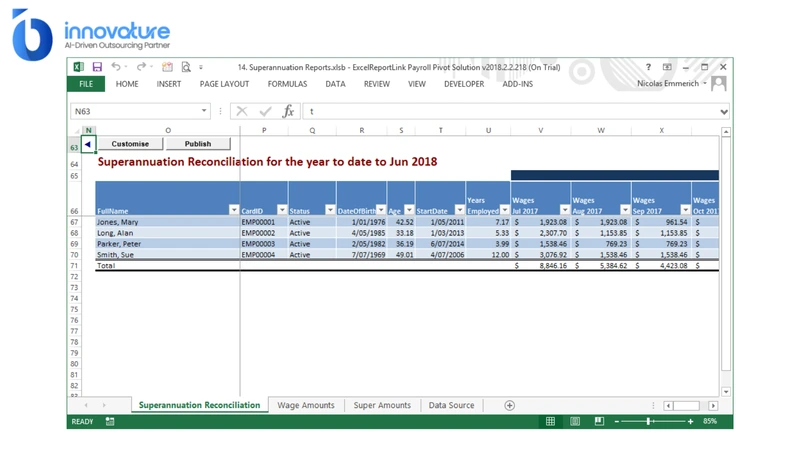
A payroll reconciliation is only reliable when each payroll amount can be traced back to an independent source. Instead of reviewing the payroll register in isolation, Finance should compare employee, payroll, payment, tax, and accounting records to confirm that the same transaction is reflected consistently across systems.
The exact reports will vary by payroll provider and accounting system, but a typical reconciliation uses the following records:
| Reconciliation Area | Compare | What Should Match |
|---|---|---|
| Employee population | HR active employee list ↔ Payroll register | Employee ID, status, hire and termination dates |
| Hours worked | Approved timesheets ↔ Payroll register | Regular hours, overtime, PTO and other paid time |
| Compensation | Approved pay-rate data ↔ Payroll register | Salary, hourly rate, bonuses and adjustments |
| Gross-to-net | Payroll register ↔ Payroll calculation | Earnings, deductions, taxes and net pay |
| Net pay | Payroll register ↔ ACH/funding file ↔ Bank | Total employee payments and payment status |
| Payroll expense | Payroll register ↔ Payroll journal ↔ GL | Wage and payroll-related expenses |
| Payroll taxes | Payroll tax report ↔ Tax liabilities and deposits | Employee withholding and employer taxes |
| Benefits | Deduction report ↔ Benefits payable | Amounts withheld, recorded and remitted |
| Payroll clearing | Payroll funding ↔ Clearing account | Settled payments and any remaining balance |
This creates a clear reconciliation trail:
HR & Time Data → Payroll Register → Payment → General Ledger → Payroll Liabilities
When a figure does not match, Finance can trace the variance to the stage where it originated rather than reviewing the entire payroll cycle again.
Why Is Payroll Reconciliation Critical for Businesses?
Payroll errors affect more than employee pay. They can also lead to incorrect payroll expenses, outstanding liabilities, tax differences, and inaccurate financial reports. This makes payroll reconciliation an important control for both Payroll and Finance teams.
The financial impact can be significant. EY’s 2022 U.S. HR Processing Risk and Cost Survey found an average payroll accuracy rate of 80.15%, while correcting a payroll error cost an average of $291. This shows why identifying discrepancies early is more effective than correcting them after payroll has been processed.
A consistent reconciliation process helps businesses:
- Prevent payroll errors: Identify overpayments, underpayments, duplicate entries, and missing adjustments before they carry into the next payroll cycle.
- Maintain accurate financial records: Ensure payroll expenses, liabilities, cash movements, and cost-center allocations match supporting records.
- Reduce compliance risk: Detect tax and deduction differences before payment or filing deadlines. In the U.S., late employment-tax deposits can trigger IRS penalties ranging from 2% to 15%, depending on the length of the delay and whether an IRS notice has been issued.
- Support close and audit readiness: Maintain clear supporting documents, variance explanations, approvals, and an audit trail.

For Finance teams, the payroll reconciliation process is therefore not just a payroll check. It is a key control for keeping payroll, accounting records, and financial reporting aligned.
The Typical 6-Step Payroll Reconciliation Process
A structured payroll reconciliation process should be completed for every payroll cycle. The goal is simple: verify the data used to calculate payroll, confirm the amounts paid, and make sure the same figures are recorded correctly in accounting.
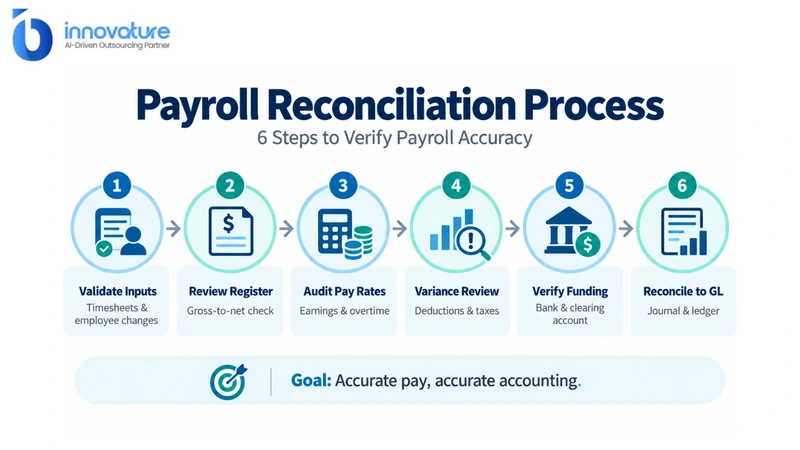
Step 1: Validate Timesheets and Employee Master Data Changes
Start by checking the information that feeds into payroll. This includes regular hours, overtime, PTO or sick leave, new hires, terminations, salary changes, department transfers, bonuses, commissions, and other approved employee updates.
A practical control is to compare:
Active Employee List ↔ Termination Report ↔ Payroll Register
This helps Finance identify employees who should no longer be paid, as well as approved changes that have not yet reached payroll.
For U.S. payroll, changes to Form W-4 information should also be reviewed when an employee updates their tax withholding instructions.
Step 2: Review and Verify the Payroll Register
Next, review the payroll register to confirm that employee IDs, pay periods, gross wages, overtime, bonuses, taxes, benefits, deductions, and net pay look reasonable.
The gross-to-net calculation should reconcile as follows:
Gross Pay – Pre-Tax Deductions – Employee Taxes – Post-Tax Deductions = Net Pay
Finance should also compare the current payroll with the previous payroll cycle. Large or unexpected changes may point to a missing employee, duplicate payment, unusual bonus, or incorrect deduction.
Step 3: Audit Pay Rates, Earnings, and Overtime
Compare payroll amounts with approved HR or compensation records.
Key items include:
- salary or hourly rate;
- overtime rate;
- bonuses and commissions;
- allowances;
- retroactive pay;
- one-time adjustments.
The main objective is to confirm that the payroll register reflects approved compensation data rather than simply carrying forward information from the previous cycle.
Typical issues include outdated salary rates, incorrect overtime calculations, duplicate bonuses, or missing retroactive adjustments.
Step 4: Perform a Payroll Variance Review for Deductions and Taxes
A payroll variance review helps Finance identify unusual movements that may not be obvious from reviewing individual employees.
Compare:
- Current payroll vs. prior payroll;
- Actual vs. expected deductions;
- Employee and employer taxes;
- Benefits and retirement contributions;
- Other recurring deductions.
A simple review process is:
Variance → Root Cause → Evidence → Owner → Resolution
Finance may also define internal thresholds. For example, a company could investigate a department whose payroll cost changes by more than 5% month over month. The 5% figure is only an example; each business should set its own threshold based on materiality and risk.
For U.S. payroll, Form 941 is also useful when reconciling federal income tax withholding, Social Security, and Medicare amounts.
Step 5: Authorize Bank Funding and Net Pay Distribution
After payroll is approved, reconcile the amount employees should receive with the amount funded through the bank or payroll provider:
Net Pay per Payroll Register ↔ Funding File ↔ Bank Transaction
Review direct deposits or ACH payments, rejected transactions, reversals, manual checks, off-cycle payroll, and incorrect bank details.
Finance should also check the payroll clearing account. After payroll payments have settled, the account should normally return to zero. If a balance remains, the team should identify and document the reason.
Gross payroll may not match one bank transaction because taxes, benefits, and other liabilities can be funded separately.
Step 6: Execute Payroll GL Reconciliation
The final step is payroll GL reconciliation, which confirms that payroll has been recorded correctly in the general ledger.
The flow is:
Payroll Register → Payroll Journal Entry → General Ledger
Finance should review payroll expenses, tax and benefit liabilities, cash or clearing accounts, departments, cost centers, and legal entities.
| Payroll Component | Typical GL Treatment | Control Activity |
| Gross wages | Dr. Wage Expense | Match to payroll register |
| Employee taxes | Cr. Tax Payable | Match to payroll tax report |
| Benefits withheld | Cr. Benefits Payable | Reconcile outstanding balance |
| Net payroll | Cr. Cash / Clearing | Match to bank funding |
| Employer taxes | Dr. Payroll Tax Expense | Match to tax calculation |
The entries above are illustrative; actual payroll journal structures may vary by accounting system and chart of accounts. Before sign-off, investigate duplicate or missing journal entries, incorrect GL or department coding, unreversed accruals, and payroll liabilities that have not cleared.
Payroll-related balances should also feed into the broader month-end close process, where Finance reviews GL balances, reconciliations, and outstanding adjustments before reporting.
Payroll Reconciliation Example
Consider a payroll register showing the following totals for one pay period:
| Payroll Item | Amount |
|---|---|
| Gross wages | $120,000 |
| Employee taxes | $22,500 |
| Pre- and post-tax deductions | $9,500 |
| Net pay | $88,000 |
The gross-to-net calculation reconciles:
$120,000 − $22,500 − $9,500 = $88,000 Net Pay
However, the bank records show that only $87,500 was successfully distributed to employees.
Payroll Register: $88,000
Bank Settlement: $87,500
Unreconciled Difference: $500
Finance should not close the reconciliation simply because the payroll calculation itself is correct. The $500 difference must be traced through the payment records.
In this example, the ACH report shows that one employee’s $500 direct deposit was rejected because of invalid bank information. The exception should be documented, assigned for correction, and tracked until the employee is paid and the related clearing-account balance is resolved.
The reconciliation trail becomes:
Payroll Register → ACH File → Bank Return → Exception Log → Corrective Payment → Clearing Account
This illustrates an important distinction: a payroll calculation can be correct while the payroll cycle is still unreconciled. Reconciliation is complete only when material differences across payroll, payment, and accounting records have been explained or corrected.
Payroll Does Not Reconcile? Start With These Checks
When payroll does not reconcile, Finance should first identify where the difference appears. A mismatch between payroll and the bank requires a different investigation from a mismatch between payroll and the general ledger.
Use the variance to determine which source records should be checked first:
| Variance | Likely Cause | Check First |
|---|---|---|
| Employee count does not match | New hire, termination, leave, or duplicate employee | HR employee master ↔ Payroll register |
| Gross wages do not match | Missing earnings, incorrect pay rate, overtime, or duplicate payment | Timesheet + Compensation records ↔ Payroll register |
| Net pay does not match bank | Rejected ACH, reversal, manual check, or off-cycle payment | Payroll register ↔ Funding file ↔ Bank |
| Payroll expense does not match GL | Missing, duplicate, or incorrectly coded journal entry | Payroll register ↔ Payroll journal ↔ GL |
| Payroll liability does not clear | Missing remittance, timing difference, or incorrect posting | Liability account ↔ Payment confirmation |
| Tax amount does not match | Withholding, tax calculation, deposit, or timing difference | Payroll tax report ↔ Tax liability ↔ Tax payment |
| Department cost is unusual | Employee transfer or incorrect cost-center mapping | Employee master ↔ Payroll allocation ↔ GL |
These issues may look small, but the cost increases when the same error affects many employees or repeats across payroll cycles. EY found an average payroll error cost of $291, while some specific errors cost considerably more to correct, including $705 for missed sick-time entries, $635 for delayed employee setup, and $539 for W-4 setup errors.
The objective is not simply to force the totals to agree. Every material difference should have an identifiable root cause, supporting evidence, owner, and resolution.
A practical exception workflow is:
Variance → Source Record → Root Cause → Corrective Action → Reviewer Approval → Close
Recurring exceptions should also be tracked across payroll cycles. If the same mismatch repeatedly appears, Finance should investigate the underlying process or system control rather than correcting the individual transaction each time.
Key Internal Controls for an Effective Payroll Reconciliation Process
A reliable payroll reconciliation process needs clear controls at each stage. The goal is not to make payroll more complicated, but to make sure errors are detected, assigned to the right person, and resolved before they affect payment or financial reporting.
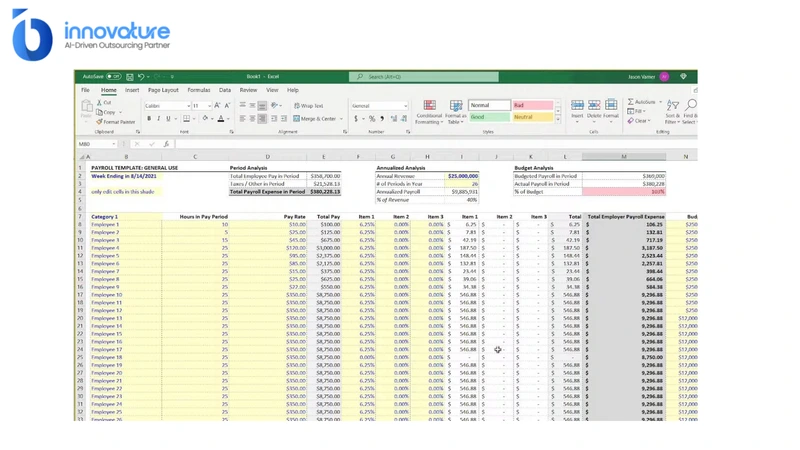
Key controls include:
- Using the same reconciliation template every payroll cycle;
- Working from approved and clearly identified source data;
- Separating payroll preparation, review, and approval responsibilities;
- Setting clear payroll cut-off dates and variance thresholds;
- Controlling GL and cost-center mappings;
- Maintaining an exception log with an owner and due date;
- Requiring reviewer sign-off before reconciliation is closed, as part of a broader accounting quality control process.
Exceptions should move through a defined review path:
Exception → Owner → Corrective Action → Review → Close
This follows the broader principles of COSO, which emphasizes control activities, reliable information, accountability, and ongoing monitoring. For U.S. payroll, timely tax controls are also important. IRS penalties for late employment-tax deposits can range from 2% to 15%, depending on how late the deposit is.
Payroll Reconciliation Checklist and Control Matrix
A standardized payroll reconciliation checklist helps Finance apply the same controls every payroll cycle and creates evidence that each reconciliation has been reviewed.
Rather than recording only whether a task was completed, the checklist should identify what is being compared, the supporting evidence, and who owns the control.
A standardized payroll reconciliation checklist helps Finance apply the same controls every payroll cycle and creates evidence that each reconciliation has been reviewed. Rather than recording only whether a task was completed, the checklist should identify what is being compared, the supporting evidence, and who owns the control.
| Control | Compare | Evidence | Owner | Status |
|---|---|---|---|---|
| Employee population | HR roster ↔ Payroll register | Employee change report | HR / Payroll | [ ] |
| Hours and leave | Approved timesheets ↔ Payroll register | Time report | Payroll | [ ] |
| Pay rates | Compensation records ↔ Payroll register | Approved rate changes | HR / Payroll | [ ] |
| Gross-to-net | Earnings ↔ Deductions ↔ Taxes ↔ Net pay | Payroll register | Payroll | [ ] |
| Net payroll | Payroll register ↔ ACH/funding file ↔ Bank | Bank/funding report | Payroll / Treasury | [ ] |
| Payroll expense | Payroll register ↔ Payroll journal ↔ GL | Journal and GL detail | Accounting | [ ] |
| Payroll taxes | Tax report ↔ Tax liability ↔ Payment | Payroll tax report | Payroll / Accounting | [ ] |
| Benefits | Deduction report ↔ Benefits payable | Benefit report | Payroll / Accounting | [ ] |
| Clearing account | Payroll funding ↔ Clearing account | GL account detail | Accounting | [ ] |
| Variances | Difference ↔ Supporting explanation | Exception log | Control owner | [ ] |
| Final review | Completed reconciliation ↔ Supporting evidence | Reviewer sign-off | Reviewer | [ ] |
The completed reconciliation, supporting reports, variance explanations, and reviewer approval should be retained together. This creates a clear audit trail showing not only that payroll was processed, but also that material differences were investigated and resolved.
When Should Payroll Be Reconciled?
Payroll reconciliation is not a single month-end activity. Different controls should be performed at different points in the payroll and accounting cycle.
| Timing | What Should Be Reconciled |
|---|---|
| Before every payroll | Employee changes, timesheets, pay rates, deductions and gross-to-net calculations |
| After payroll processing | Payroll register, ACH or funding file, rejected payments and bank settlement |
| Month-end | Payroll journal entries, expenses, liabilities and clearing accounts |
| Quarterly | Payroll tax records, federal tax deposits and Form 941 |
| Year-end | Annual payroll records and Forms W-2 and W-3 |
The most important operational controls should therefore be completed during every payroll cycle, rather than waiting until month-end or quarter-end to identify errors.
For U.S. employers, quarterly and year-end reconciliations provide an additional control over payroll tax reporting. Differences between payroll records, tax liabilities, deposits, and filed forms should be investigated before the relevant filing is finalized.
How Innovature BPO Supports Payroll Reconciliation

When the payroll reconciliation process becomes more complex, Finance teams often need broader Finance & Accounting support across both payroll operations and the accounting activities that follow. Innovature BPO can support key parts of this workflow, including:
- Timesheet validation and payroll support to improve the accuracy of payroll inputs.
- Payroll report review to identify missing or unusual items before reconciliation is completed.
- Bank and clearing-account reconciliation to confirm payroll funding and settlement.
- Payroll liability reconciliation for taxes, benefits, and other payroll-related balances.
- GL support and variance review to investigate differences between payroll records and accounting entries.
- Month-end close support to ensure payroll-related balances are properly reviewed before reporting.
These capabilities are reflected in Innovature’s accounting workflows, which include gathering payroll reports and reconciling bank, clearing, and liability accounts.
In one broader shared-service engagement, Innovature supported a U.S. technology staffing company with more than US$1 billion in annual revenue. The scope included timesheet validation, payroll support, general ledger, bank reconciliation, and month-end close.
The engagement recorded an 82% reduction in payroll error rate and a 30% faster month-end close. While these results came from the broader shared-service transformation, they show Innovature’s ability to combine payroll support with accounting reconciliation and controls at enterprise scale.
If payroll reconciliation is becoming difficult to manage across systems, entities, or payroll cycles, contact Innovature BPO for structured Finance & Accounting support.
Payroll Reconciliation FAQs
What Does Payroll Reconciliation Mean?
Payroll reconciliation is the process of verifying payroll calculations against independent records—such as timesheets, bank files, and the general ledger—to ensure employees are paid correctly and books balance. It prevents payment errors, tax penalties, and accounting discrepancies before and after funds are disbursed.
How Often Should Payroll Reconciliation Be Performed?
Payroll reconciliation should be performed during every payroll cycle, with key checks completed before payroll approval and additional reconciliation performed after payment. Payroll liabilities, clearing accounts, and other related balance-sheet accounts should also be checked during month-end close.
What Is Payroll GL Reconciliation?
Payroll GL reconciliation means comparing payroll reports and journal entries with the related accounts in the general ledger, such as payroll expenses, liabilities, cash, and clearing accounts.
Any difference should be explained or corrected before the reconciliation is approved.
What Should a Payroll Reconciliation Checklist Include?
A payroll reconciliation checklist should cover employee and time data, pay rates, gross-to-net calculations, taxes and deductions, bank funding, payroll journals, GL reconciliation, variance resolution, and final reviewer approval.
How to Perform a Payroll Reconciliation?
Perform it in six steps: validate timesheets and master data, verify gross-to-net calculations, audit pay rates, review deduction and tax variances, match net pay with bank funding, and reconcile journals to the GL. Any unexplained difference must be resolved before closing the payroll cycle.


Finance leaders are under pressure to strengthen controls, close faster, improve data quality, and support business decisions without…

Vendor master data controls govern how supplier records are created, verified, approved, changed, and deactivated before they are…

Accounts receivable aging analysis helps finance teams evaluate unpaid customer invoices, identify overdue exposure, and decide which balances…

Finance outsourcing governance is a framework that defines roles, decision rights, internal controls, and provider oversight when finance…

Selecting a finance outsourcing provider does not make a finance process ready to move. Before operational ownership changes…

PayrollOrg’s 2025 survey found that 38% of organizations do not track payroll performance, showing that payroll oversight remains…
Intercompany balances become harder to control as businesses add legal entities, currencies, systems, and cross-border transactions. A single…

An accounting quality control checklist helps Controllers and Finance Managers verify whether bookkeeping data is accurate, supported, and…

Month-end close often becomes harder as growing companies process more invoices, payments, reconciliations, and reporting requirements. Without a…

Accounts payable journal entries record what a business owes suppliers and how those obligations change over time. A…

Financial statements analysis is the process of examining a company’s income statement, balance sheet, and cash flow statement…

An offshore accounting strategy defines which finance work should move offshore, how that work will be delivered, who…
Ready to move faster?
Trust us to find the best-fit candidates while you concentrate on building a skilled and diverse remote team.